








TL;DR: SOC 2 reports
- A SOC 2 report gives customers independent, auditor-verified evidence that your security controls effectively protect their data.
- Many enterprise customers require a valid SOC 2 report as a minimum condition before signing a vendor contract.
- SOC 2 compliance strengthens brand reputation, reduces breach risk, and lowers the long-term cost of security incidents.
- Getting a SOC 2 report involves scoping, a readiness assessment, control implementation, evidence collection, and an independent CPA audit.
- Scytale’s AI GRC platform streamlines SOC 2 through automated evidence collection, continuous monitoring, and expert-guided audit readiness.
A SOC 2 report provides the evidence organizations and their customers need to confirm that information security controls are capable of protecting user data. It communicates how seriously an organization treats information security and demonstrates that effective measures are in place to prevent breaches, data leaks, and other incidents that could damage its reputation.
As a result, SOC 2 is more than a compliance standard. Achieving SOC 2 compliance is a sound business decision that supports customer trust, sales growth, and long-term resilience. In this article, we outline six reasons your business needs a SOC 2 report, explain how to obtain one, and answer common questions about the process.
Benefits of SOC 2 compliance
SOC 2 compliance delivers value beyond meeting customer security requirements, particularly for SaaS companies that store or process sensitive data. It helps businesses build customer trust, strengthen security practices, and unlock new growth opportunities. Here are six key benefits of obtaining a SOC 2 report:
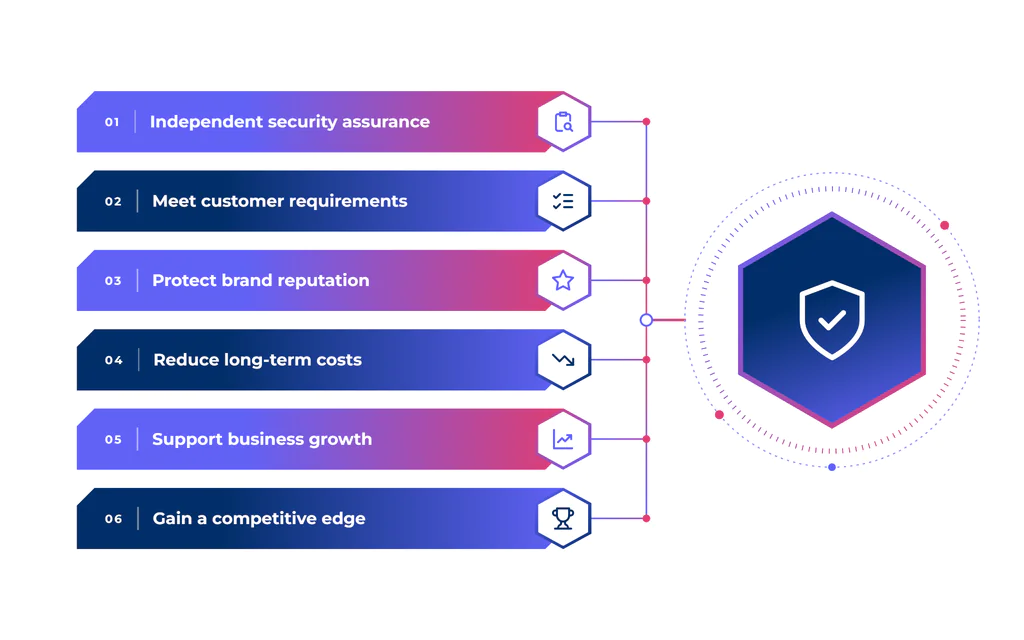
1. Independent security assurance
A SOC 2 report provides independent verification of an organization’s security controls, giving customers and partners credible evidence rather than verbal assurances. Unlike a certification, SOC 2 is an attestation conducted by an independent auditor according to standards established by the American Institute of Certified Public Accountants (AICPA).
The report evaluates how an organization designs and implements controls to protect customer data. A SOC 2 Type II report goes further by assessing control effectiveness over a defined period, providing stronger assurance that security practices operate consistently over time.
2. Meet customer requirements
Customers increasingly expect vendors to demonstrate strong data security practices before entering business relationships. For SaaS companies, a SOC 2 report is often a key requirement during vendor assessments, procurement processes, and contract negotiations.
Meeting SOC 2 requirements helps organizations satisfy customer expectations, maintain existing relationships, and access new business opportunities. As customers introduce stricter security standards, maintaining SOC 2 compliance also supports long-term retention and reduces potential barriers to growth.
3. Protect brand reputation
SOC 2 compliance helps organizations strengthen their security posture and demonstrate a commitment to protecting sensitive customer information. Establishing effective controls and regularly assessing security risks can reduce vulnerabilities that might otherwise lead to data breaches or operational disruptions.
A security incident can result in financial losses, damaged customer relationships, and lasting reputational harm. While SOC 2 cannot eliminate these risks, independent audits help organizations identify control weaknesses, improve security practices, and build greater confidence among customers and stakeholders.
4. Reduce long-term costs
Achieving SOC 2 compliance requires an initial investment, but establishing effective security controls can help organizations avoid costly incidents, inefficient processes, and repeated manual security assessments. Identifying weaknesses early also reduces the likelihood of expensive remediation efforts later.
Modern SOC 2 compliance software simplifies compliance management through automated evidence collection, continuous monitoring, and centralized workflows. By reducing manual effort and improving operational efficiency, businesses can lower ongoing compliance costs while maintaining audit readiness.
5. Support business growth
Establishing SOC 2 controls early helps SaaS companies build a scalable security foundation. Rather than introducing complex security processes after rapid expansion, organizations can integrate risk management, access controls, and data protection practices into their operations from the start.
As businesses grow, these established controls can evolve alongside new systems, employees, and customer requirements. Involving leadership and assigning clear responsibilities also helps create a security-conscious culture that supports sustainable growth and long-term compliance.
6. Gain a competitive edge
SOC 2 compliance helps businesses differentiate themselves from competitors that cannot provide independent assurance of their security practices. A completed SOC 2 audit demonstrates a commitment to protecting customer data and gives potential buyers greater confidence in their vendor selection.
For SaaS companies selling to security-conscious organizations, a SOC 2 report can also accelerate sales cycles by simplifying security reviews and reducing procurement delays. This competitive advantage helps businesses pursue larger customers, enter new markets, and secure more opportunities.
Streamline GRC workflows with seamless automation.
How do I get a SOC 2 report?
Obtaining a SOC 2 report involves several key stages, from defining your audit scope to completing an independent audit conducted by a licensed CPA firm. Understanding this process helps organizations plan their compliance journey, establish realistic timelines, and meet customer security requirements. Here are the five key steps to obtaining a SOC 2 report:
1. Define your audit scope
Identify the systems, services, and Trust Services Criteria relevant to your organization. Security is mandatory, while Availability, Confidentiality, Processing Integrity, and Privacy are included based on your business operations and customer requirements.
2. Choose your SOC 2 report type
Determine whether you need a SOC 2 Type I or Type II report. Type I evaluates the design of controls at a specific point in time, while Type II assesses their operating effectiveness over a defined observation period, typically three to twelve months.
3. Conduct a readiness assessment
Perform a gap analysis to evaluate your existing security controls against SOC 2 requirements. This helps identify weaknesses, prioritize remediation efforts, and address potential issues before the formal audit begins.
4. Implement controls and collect evidence
Establish the necessary security policies, access controls, risk management procedures, and monitoring processes. Collect supporting evidence to demonstrate that controls are properly implemented and, for Type II reports, operating effectively throughout the observation period.
5. Complete your SOC 2 audit
Engage an independent CPA firm to evaluate your controls and supporting documentation. The auditor reviews the evidence, performs the required testing, and issues a SOC 2 report containing its findings and audit opinion.
The SOC 2 process can take several months, depending on the report type, organizational readiness, and complexity of the audit scope. Maintaining continuous compliance and regularly updating evidence helps simplify future audits, particularly since customers typically expect an updated SOC 2 report annually.
For example, Leen achieved SOC 2 compliance in just four months using Scytale, despite having no prior compliance experience or in-house security hire.
SOC 2 audit process at a glance
| Step | Key activities | Expected outcome |
| Define audit scope | Identify relevant systems and Trust Services Criteria | Clear audit boundaries and requirements |
| Choose report type | Select SOC 2 Type I or Type II | Report aligned with business needs |
| Assess readiness | Review controls and identify compliance gaps | Prioritized remediation plan |
| Implement controls | Establish policies, monitor controls, and collect evidence | Documented security practices and audit evidence |
| Complete audit | Independent CPA reviews and tests controls | Final SOC 2 report and auditor’s opinion |



Preparing for SOC 2 compliance
Preparing for SOC 2 compliance involves understanding SOC 2 requirements, strengthening internal security practices, and ensuring your organization meets the relevant Trust Services Criteria. Establishing clear responsibilities and effective controls helps reduce last-minute audit challenges, improve evidence management, and maintain long-term compliance. Here are five practical ways to prepare your business for SOC 2 compliance:
Establish clear security responsibilities
Assign control owners and define responsibilities across relevant departments, including IT, security, HR, and leadership. Clear accountability helps ensure security policies are followed, compliance tasks are completed on time, and potential issues are addressed before they affect audit readiness.
Strengthen internal security practices
Review your organization’s existing security procedures and identify opportunities to improve access management, incident response, employee training, and vendor oversight. Building these practices into everyday operations helps establish a stronger security foundation and supports consistent control effectiveness.
Organize compliance documentation
Maintain accurate, up-to-date records of security policies, employee training, access reviews, risk assessments, and other compliance activities. Centralizing documentation makes it easier to locate supporting evidence, respond to auditor requests, and avoid unnecessary delays during the audit.
Maintain continuous compliance
SOC 2 compliance requires ongoing attention beyond the initial audit. Regular control reviews, continuous monitoring, and updated documentation help organizations identify security gaps early, maintain audit readiness, and simplify future assessments.
Follow a SOC 2 compliance checklist
Using a structured checklist helps organizations track requirements, prioritize tasks, and avoid overlooking critical audit preparation steps. Scytale’s comprehensive SOC 2 compliance checklist provides practical guidance to help businesses prepare efficiently and confidently for their SOC 2 audit.
Always-on GRC. Built for modern teams.
Streamline SOC 2 compliance with Scytale
Scytale‘s AI GRC platform helps organizations get their SOC 2 report faster by automating evidence collection, continuously monitoring controls, and centralizing audit preparation. This reduces the manual effort behind readiness assessments and audits, allowing teams to focus on growth while staying audit-ready year-round.
Scytale also supports multi-framework compliance, mapping controls across SOC 2, ISO 27001, HIPAA, GDPR, and SOX ITGC to eliminate duplicate work. Combined with a customizable Trust Center and dedicated GRC experts, Scytale helps organizations achieve and maintain SOC 2 compliance with greater confidence.
FAQs about SOC 2 reports
What is a SOC 2 report?
A SOC 2 report is an independent attestation, issued by a licensed CPA firm, that evaluates how well an organization’s controls protect customer data. It is based on the AICPA’s Trust Services Criteria and describes the controls in place, how the auditor tested them, and the results.
Why does your business need a SOC 2 report?
A SOC 2 report gives customers verified proof that your organization handles their data securely, which shortens security reviews and removes common barriers in enterprise deals. It also strengthens internal security practices and reduces the likelihood and impact of a data breach.
How does a SOC 2 report help build customer trust?
Instead of relying on self-reported security claims, customers receive an objective assessment from an independent auditor. A Type II report goes further by showing that controls operated effectively over time, and leading AI GRC platforms like Scytale help teams share that evidence through a Trust Center.
Is a SOC 2 report mandatory for all companies?
No, SOC 2 is a voluntary framework and no law requires it. However, it is often a contractual expectation for SaaS companies, cloud service providers, and other vendors that store or process customer data, particularly when selling to North American enterprises.
When should a startup start preparing for a SOC 2 report?
Startups should generally begin preparing once they sell to mid-market or enterprise customers, or as soon as prospects start sending security questionnaires. Starting early makes it easier to build controls into processes from the beginning, and Scytale’s AI GRC platform helps startups reach audit readiness faster through automation and expert guidance.


