


TL;DR: SOC 2 compliance UK
- SOC 2 compliance is not legally required in the UK, but often expected by US customers and enterprise buyers during vendor reviews.
- It helps UK companies demonstrate secure data handling using recognized security and privacy standards.
- SOC 2 compliance involves meeting the relevant Trust Services Criteria (TSC) to secure customer data.
- The SOC 2 audit process ensures your company meets security standards by identifying and addressing compliance gaps, keeping you audit-ready.
- Top AI SOC 2 compliance automation platforms like Scytale streamline your compliance process from start to finish, saving time and ensuring your organization stays compliant.
Cyberattacks destroy trust, disrupt business, and can even end careers. For companies based in the United Kingdom (UK) handling sensitive data or offering digital services, the impact of a breach is severe. As cyber threats become more frequent and sophisticated, organizations must implement strong security and compliance measures to protect customer data and meet industry standards. SOC 2 compliance provides a clear framework for adhering to strict security and privacy standards, helping companies manage data protection and risk mitigation.
In this article, we’ll explore what SOC 2 compliance is, why it’s crucial for UK companies, and how the process of achieving and maintaining SOC 2 compliance can be streamlined with leading compliance automation platforms like Scytale.
What is SOC 2 compliance?
SOC 2 is a compliance framework created by the American Institute of Certified Public Accountants (AICPA) to help organizations protect customer data and maintain secure systems. It is based on five key criteria: security, availability, processing integrity, confidentiality, and privacy, known as the Trust Services Criteria (TSC). These criteria guide organizations in implementing controls to ensure their systems operate securely and efficiently.
For UK companies, achieving SOC 2 compliance demonstrates a strong commitment to meeting global standards and builds long-term trust with customers and partners. This is especially important when working with US-based organizations and expanding into international markets.
A SOC 2 audit assesses how well a company has implemented controls to meet the Trust Services Criteria over a set period. While often referred to as SOC 2 certification, it is technically an audit report issued by an independent auditor. Compliance with SOC 2 provides UK companies with a structured approach to secure their systems, mitigate risks, and gain a competitive edge in the global market.
Does SOC 2 apply to UK companies?
SOC 2 is a US-based framework, but it’s highly relevant for UK companies, especially in SaaS, fintech, and data-driven industries. While not legally required in the UK, it has become a standard for international organizations due to rising security and GRC expectations. Here are the key reasons why SOC 2 is relevant for UK companies:
US customer requirements
Many American organizations require vendors to provide a SOC 2 report before signing a contract. Without it, UK companies may face challenges entering or expanding in the US market.
Enterprise vendor security reviews
Large organizations expect vendors to prove they follow strong security and data protection practices. A SOC 2 audit in the UK provides clear and consistent evidence during procurement and due diligence.
Global expansion
As organizations expand into new markets, having a recognized Governance, Risk and Compliance (GRC) framework establishes trust with customers, partners, and investors. For many UK companies, SOC 2 is a crucial step in scaling securely and demonstrating commitment to data protection and reliability.
SOC 2 requirements for UK companies
SOC 2 requirements focus on implementing and maintaining controls that align with the Trust Services Criteria (TSC). For UK companies, this means putting structured processes in place to protect systems and data while ensuring continuous monitoring and accountability. Here are the key control areas required for SOC 2 compliance:
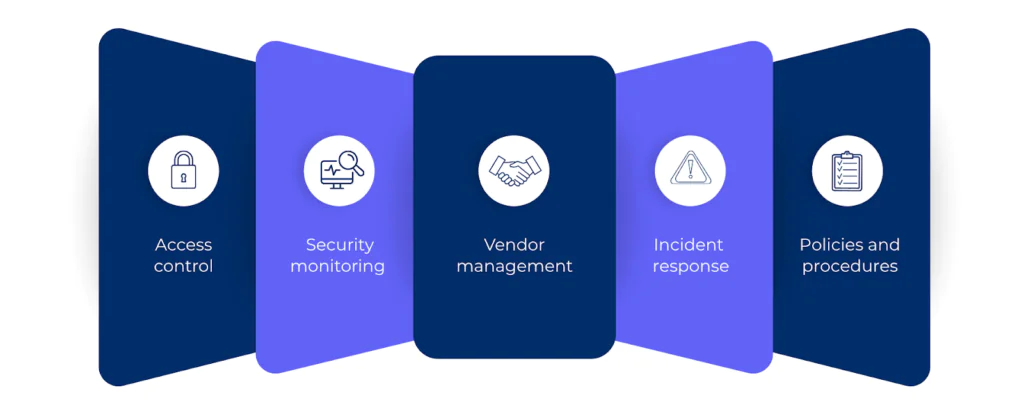
Access control
Access control ensures that only authorized users can access systems and sensitive data. This involves using strong authentication and clear role-based permissions. Together, these measures reduce the risk of unauthorized access and potential security incidents.
Security monitoring
Security monitoring involves continuously tracking system activity to detect potential threats. This allows organizations to identify unusual behaviour early and respond quickly. Continuous monitoring also helps maintain visibility and strengthens overall security posture.
Vendor management
Vendor management focuses on assessing and managing risks from third-party providers. Organizations must ensure that vendors meet required GRC standards. This reduces the likelihood of external vulnerabilities impacting internal systems.
Incident response
Incident response requires having clear processes in place to identify and manage security incidents. Teams need to respond quickly, contain issues, and minimize impact on operations. Well-defined plans also ensure consistent handling and reporting of incidents.
Policies and procedures
SOC 2 policies and procedures document how security practices are implemented across the organization. They provide clear guidance for employees and ensure consistency in how controls are applied. Strong documentation also supports audit readiness and accountability.


SOC 2 audit process explained
The SOC 2 audit process for UK companies follows a structured approach to evaluate how well your organization meets the Trust Services Criteria. Here are some of the key stages in the audit process:
Gap assessment
The first step in preparing for a SOC 2 audit is a gap assessment. During this stage, your company’s current controls are reviewed against the SOC 2 requirements. The goal is to identify any missing policies, weak processes, or areas in need of improvement, forming the basis for remediation.
Remediation
Once gaps are identified, the next step is remediation. This involves addressing the gaps by implementing new controls, updating existing policies, or enhancing monitoring and documentation practices. Remediation ensures that your systems are aligned with the SOC 2 criteria before the audit takes place.
Type I vs Type II audit
After remediation, your company will choose between a Type I or Type II audit. A Type I audit assesses whether the controls are appropriately designed at a specific point in time. A Type II audit evaluates the design and effectiveness of these controls over a defined period (typically 3 to 12 months).
Audit timelines
Audit timelines can vary based on your organization’s preparedness. Preparation for the audit may take anywhere from several weeks to a few months. For SOC 2 type 2 audits, an observation period is required before the final report can be issued, which extends the timeline.
Scytale’s support in the audit process
Scytale streamlines the SOC 2 audit process by bringing structure and clarity to every stage. Our AI GRC platform ensures that your organization stays audit-ready, while our team of dedicated GRC experts provides guidance through each step. With Scytale, the audit process becomes more efficient and less time-consuming, allowing you to focus on business growth while we ensure your compliance and security.
Always-on GRC. Built for modern teams.
How to get SOC 2 compliant in the UK
Achieving SOC 2 compliance in the UK involves a series of structured steps. While the process may seem complex, breaking it down into clear stages makes it much more manageable. Here’s a step-by-step process on how to get SOC 2 compliant in the UK:
Step 1: Define the scope
The first step is to define the scope of your audit. This involves identifying the systems, processes, data, and teams that are involved in the compliance effort. A clear and well-defined scope ensures the audit remains focused and relevant, helping avoid unnecessary complexity.
Step 2: Select the Trust Services Criteria
Next, you need to select the Trust Services Criteria that apply to your organization. Security is mandatory for all companies, while the other criteria, Availability, Processing Integrity, Confidentiality, and Privacy, are chosen based on your services and customer expectations. These criteria ensure that your organization complies with data protection industry standards.
Step 3: Implement controls
After selecting the criteria, you’ll need to implement controls to meet them. This includes setting up access controls to manage who can access your systems, security monitoring to track potential threats, and documented policies that outline your security practices. These controls form the foundation of your SOC 2 compliance automation software.
Step 4: Collect evidence
Once controls are in place, collect evidence to demonstrate that they are working effectively. This evidence is required by auditors to prove that your controls meet the Trust Services Criteria. It may include logs, screenshots, policy documents, and other forms of proof that your controls are functioning as intended.
Step 5: Work with an independent auditor
Finally, work with an independent auditor who will assess your controls and issue your SOC 2 report. The auditor will evaluate whether your controls meet the required criteria over a specific period. Based on their assessment, they will provide a SOC 2 report that outlines your compliance.
5 steps to get SOC 2 compliant in the UK
| Step | Description |
| Define scope | Identify systems, processes, and data included in the audit |
| Select criteria | Choose relevant Trust Services Criteria based on your organization |
| Implement controls | Establish security, monitoring, and policy controls |
| Collect evidence | Collect documentation and evidence of control effectiveness |
| Work with auditor | Complete the audit and receive your SOC 2 report |
SOC 2 cost in the UK
The cost of SOC 2 compliance for companies based in the UK can vary based on company size, complexity, and preparation. It typically includes three main components:
Audit costs
SOC 2 audit costs generally range from £9,000 to £45,000. The final cost depends on factors like audit type, the scale of your systems, and the auditor’s reputation. Prestigious firms may charge higher fees because their reports are often more trusted.
Internal resources
Preparing for SOC 2 requires significant internal effort. Security, engineering, and GRC teams may spend weeks or months on controls, evidence gathering, and audit readiness. Additional costs may include Security Awareness Training (£2,000), policy documentation assistance (£6,000), and a risk assessment (£1,500).
Tools and software
SOC 2 compliance software like Scytale help reduce SOC 2 costs by streamlining processes such as control mapping and audit preparation. Automation can save SaaS startups over ~£20,000 and 300 hours while improving operational efficiency. By automating critical processes, companies reduce errors, cut additional costs, and ensure real-time audit readiness as they scale.
While SOC 2 compliance can be costly, it’s crucial to balance these expenses with the risks of non-compliance, such as lost business and reputational damage, especially for UK businesses looking to expand globally.

Why SOC 2 matters for UK companies
SOC 2 compliance has become a key factor in how UK companies build and scale their organizations. Here are the main reasons why SOC 2 matters for UK companies:
Enables faster enterprise deals
Many large organizations require a SOC 2 report before moving forward with vendors. Having this compliance in place removes friction in the sales process, enabling UK companies to close deals more quickly with enterprise customers.
Builds trust with customers and partners
Achieving SOC 2 compliance fosters long-term trust with customers and partners. By demonstrating strong security practices and data management, businesses reassure stakeholders that their sensitive information is handled responsibly. This trust can make the difference between securing or losing business, particularly with global customers.
Creates a significant competitive advantage
SOC 2 compliance offers a competitive advantage in crowded markets. As more organizations require their vendors to meet SOC 2 standards, UK companies that are compliant stand out.
A strategic investment
SOC 2 should be viewed as a strategic investment. It supports revenue growth by opening doors to larger customers and strengthens a company’s credibility. By streamlining security practices, SOC 2 helps businesses scale efficiently without compromising security or compliance.
Get SOC 2 Compliant 90% Faster
Streamline SOC 2 compliance in the UK with Scytale
If your organization is based in the UK and is looking to get SOC 2 compliant or improve your current SOC 2 compliance management process, Scytale helps you move forward with clarity and control. The AI GRC platform enables continuous compliance through real-time monitoring, giving you full visibility into your security and risk posture, while AI-powered automation streamlines key processes like user access reviews, multi-framework cross-mapping and vendor risk management.
Combined with tailored GRC guidance and a fully customizable Trust Center that lets you easily showcase your company’s security and compliance, Scytale helps you meet SOC 2 requirements with confidence.
FAQs about SOC 2 compliance UK
What is SOC 2 compliance in the UK?
SOC 2 compliance in the UK refers to adopting a US-developed framework that assesses how organizations manage and protect customer data. It is based on the Trust Services Criteria and is widely used by UK companies that serve global markets or handle sensitive data, particularly in SaaS and technology sectors. AI-driven SOC 2 compliance automation platforms like Scytale optimize the compliance process by enhancing efficiency through automation and real-time monitoring.
Is SOC 2 required for UK companies?
SOC 2 is not a legal requirement in the UK. However, it is often commercially necessary, especially for organizations working with US customers or large enterprises. Many organizations require a SOC 2 report as part of their vendor due diligence process before entering into a business relationship.
How long does SOC 2 take in the UK?
SOC 2 compliance usually takes between 3 and 12 months. This includes time for gap assessment, implementing and testing controls, and completing the audit. A Type I audit is quicker, while a Type II audit requires a monitoring period to demonstrate ongoing control effectiveness.
How much does SOC 2 cost in the UK?
SOC 2 costs in the UK typically range from £9,000 to £45,000 for the audit itself. Additional costs arise from internal resources, preparation time, and compliance tools. The total cost depends on your organization’s size, complexity, audit scope, and the level of remediation required before the audit. Top SOC 2 compliance tools like Scytale reduce costs by automating key processes like evidence collection, saving time and resources while ensuring continuous audit readiness.


