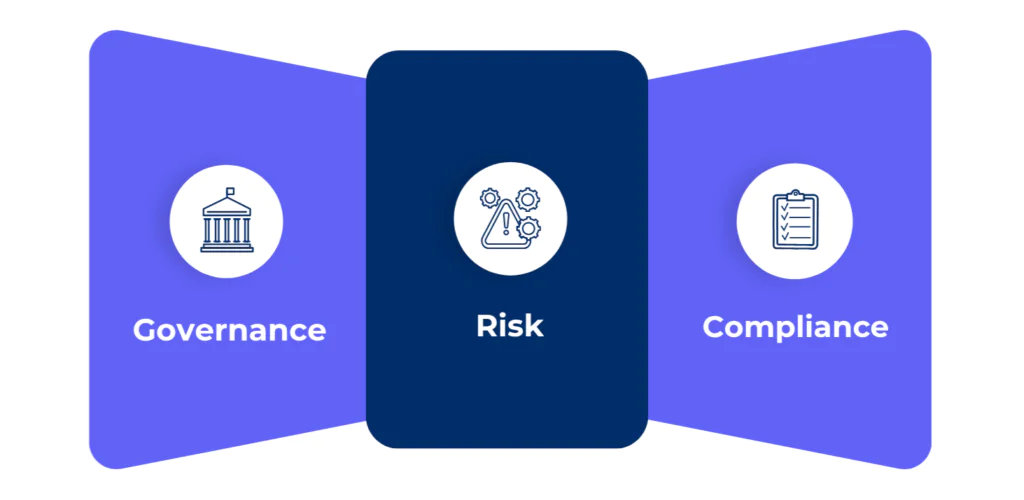
A GRC framework is a structured set of guidelines that helps organizations align governance, risk management, and compliance activities. It gives teams a clear way to manage policies, handle risks, and meet compliance requirements in a consistent and organized way.
What Is a GRC Framework?
A GRC framework provides the structure for how an organization manages its Governance, Risk, and Compliance (GRC) efforts in a consistent and scalable way. It defines how policies are created and enforced, how risks are identified and mitigated, and how compliance requirements are tracked and met across the company. Instead of working in silos, it connects these areas into one system, helping teams stay organized, reduce compliance gaps, and maintain visibility.
It’s important to distinguish between GRC as a concept and the frameworks used to implement it. GRC is the overall approach to managing governance, risk, and compliance.Frameworks like SOC 2, ISO 27001, HIPAA, GDPR, and SOX ITGC are specific standards or models that organizations adopt to put that approach into practice. Each one offers its own set of controls and best practices, depending on the organization’s industry, goals, and regulatory needs.
Streamline GRC workflows with no blind spots.
What Are the Most Common GRC Frameworks?
Most organizations rely on a combination of frameworks based on their industry, customer expectations, and regulatory requirements. Each framework serves a different purpose, and together they help create a more complete and resilient compliance program.
Choosing the right mix depends on your business model, the data you handle, and the markets you operate in. Many organizations start with one framework and expand over time as their requirements grow.
Here are some of the most common GRC frameworks:
SOC 2
SOC 2 is widely used by SaaS and technology companies to demonstrate strong security and data handling practices. It focuses on trust services criteria (TSC) such as security, availability, processing integrity, confidentiality, and privacy, and is often a baseline requirement for enterprise sales and security reviews.
ISO 27001
ISO 27001 is an international standard for building and maintaining an information security management system (ISMS). It takes a structured, risk-based approach to managing sensitive information and is recognized globally. Organizations aiming to scale internationally or formalize their security practices often adopt ISO 27001 as a foundation.
NIST Cybersecurity Framework
NIST CSF provides a flexible framework for managing cybersecurity risk, built around five core functions: identify, protect, detect, respond, and recover. It’s widely used by US-based organizations, especially those working with government or critical infrastructure, but are adaptable across industries.
HIPAA
HIPAA sets strict requirements for protecting sensitive patient data in the healthcare sector. It applies to healthcare providers, insurers, and any organization handling protected health information (PHI). Compliance is essential not only for legal reasons but also for maintaining patient trust.
GDPR
GDPR governs how personal data of EU residents is collected, stored, and processed. It applies to any organization handling EU data, regardless of where the company is based. The regulation emphasizes data privacy, transparency, and accountability, with significant penalties for non-compliance.
PCI DSS
PCI DSS focuses on securing payment card data and applies to any organization that processes, stores, or transmits cardholder information. It’s especially relevant for e-commerce, fintech, and any payment-driven company where protecting financial data is critical.
SOX ITGC
SOX ITGC focuses on ensuring the integrity and reliability of financial reporting systems. It applies to publicly traded companies and organizations preparing for IPO, covering areas such as access controls, change management, and system operations to support accurate financial reporting.
Choosing the right GRC framework starts with your business context. Look at your industry, the type of data you handle, and what your customers expect from you. For example, operating in Europe makes GDPR and the EU AI Act essential, while SOC 2 is often required to meet enterprise customer expectations and pass security reviews.
Geographic scope also plays a key role. Compliance and security requirements vary across regions, so your framework choice should reflect where you operate today and where you plan to expand. Regulatory requirements, customer contracts, and your internal risk tolerance all influence which frameworks you need to adopt and how quickly.
In most cases, one framework isn’t enough. Organizations often layer multiple frameworks to cover different requirements as they scale. The goal isn’t to check more boxes, but to build a structured, scalable GRC program that reduces risk, supports growth, and avoids unnecessary duplication through effective control mapping.
Can You Use Multiple GRC Frameworks?
Yes, and for most organizations, it’s not optional. Different frameworks address different requirements, whether it’s customer expectations, regulatory obligations, or industry standards. As companies grow, expand into new markets, or sell to larger enterprise customers, they often need to align with more than one framework at the same time.
This is where control mapping becomes critical. Many security and privacy frameworks share similar controls, so instead of duplicating work, a single control can be mapped across multiple frameworks. That means collecting evidence once and using it in multiple places. When done right, this reduces manual effort, keeps everything consistent, and prevents teams from managing the same requirements in parallel.
AI-native GRC for how teams work today.
How Scytale Supports Multiple Frameworks
Scytale helps organizations manage multiple frameworks through a centralized and structured AI GRC platform. Rather than relying on fragmented tools and processes, teams can manage policies, risks, controls, and reporting in one place, with support for 80+ frameworks. This creates consistency across the compliance program and improves visibility for customers and stakeholders.
Within this unified approach, core compliance activities such as access reviews, risk assessments, and vendor risk management are built into automated workflows. This reduces manual effort and improves operational efficiency, while real-time dashboards provide a clear view of compliance status, ownership, and progress.
To support this further, Scytale combines its platform with expert GRC support, helping SaaS organizations navigate complex requirements and stay aligned as their compliance needs change.