










TL;DR: Agentic AI security
- Agentic AI security focuses on protecting AI agents that plan, act, and use tools with limited human input.
- AI agents create different risks than traditional AI models because they take actions, access systems, and chain decisions across tools.
- Strong agentic AI security depends on least-privilege access, approval gates, logging, identity controls, and continuous testing.
- Frameworks such as OWASP, NIST AI RMF, and ISO 42001 help teams structure securing agentic AI in a repeatable way.
- Scytale’s AI GRC platform helps teams connect agentic AI governance, compliance evidence, and control monitoring in one program.
AI agents no longer stop at answering prompts. They query databases, update tickets, send messages, and change system settings across business workflows, often with limited human review. That shift moves the core security question from what a model says to what an agent is allowed to do.
Adoption is moving faster than most security programs can adapt. According to McKinsey’s State of AI 2025 survey, 62% of organizations are at least experimenting with AI agents, often before their controls, identities, and audit trails are ready for autonomous workflows. In this article, we break down the main risks AI agents introduce and the controls, frameworks, and governance practices that keep them in check.
What is agentic AI security?
Agentic AI security is the set of controls, monitoring practices, and governance rules used to protect AI agents as they reason, access tools, handle data, and act inside business systems.
Traditional AI security typically centers on model misuse, data exposure, and unsafe outputs. Agentic AI security adds a further layer because the model now operates inside workflows with permissions, memory, identities, and execution paths. A chatbot answering a question carries one risk profile, while an agent updating tickets, querying databases, or changing configurations creates a much broader operational and security surface.
In practice, the difference comes down to actionability. Securing agentic AI means governing what an agent can reach, what it can change, and how its decisions are recorded, not only what it generates. That broader surface ties closely to AI security posture management, since teams need continuous visibility into where agents run, what they access, and which controls fail first.
Streamline GRC workflows with no blind spots.
Why AI agents create new security risks
AI agents create risk because they connect reasoning with execution. Once an agent selects tools, sequences actions, and retains context, a single flawed decision can extend far beyond an incorrect text response. Connected to email, code repositories, cloud consoles, or internal knowledge bases, agents inherit the attack surface of every system they access, allowing a single poisoned input to trigger unintended actions.
Persistent memory introduces additional risks, as agents retain context across sessions and tasks. Sensitive information, customer data, or unsafe instructions stored in memory can influence future actions. Agent identity also affects security, since operating through shared service accounts, delegated users, or distinct machine identities changes accountability and the ability to contain threats.
These risks explain why AI agent security requires more than traditional application security measures. Organizations must account for how agents make decisions, access systems, and execute actions, making agent security an essential part of a broader AI risk management approach.
Top agentic AI security risks
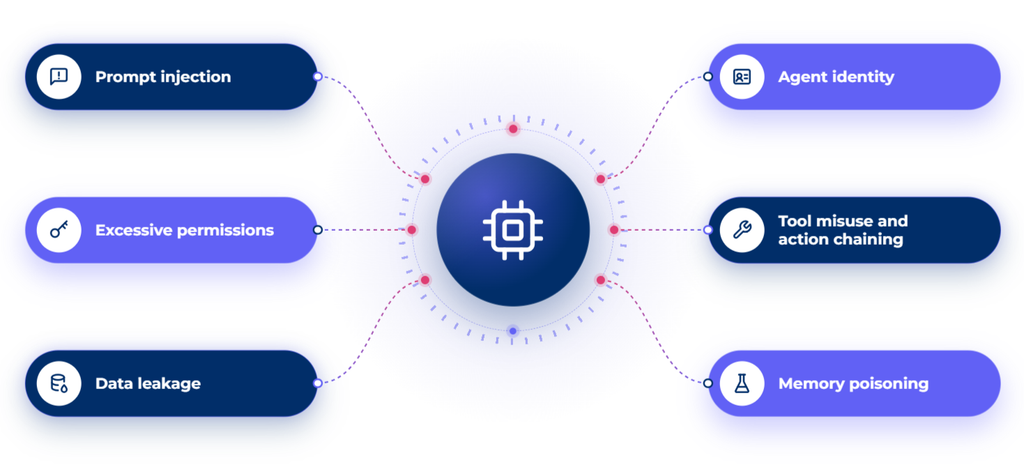
The most serious agentic AI risks appear where autonomy meets access. When agents interpret instructions, choose tools, and act across systems, small control gaps can turn into large operational failures, so a structured AI threat and risk assessment before broad deployment helps separate theoretical concerns from real exposures. Here are the top agentic AI security risks to evaluate:
1. Prompt injection
Prompt injection remains one of the clearest threats because agents read and act on external content while deciding what to do next. Malicious instructions hidden in emails, documents, web pages, or support tickets can redirect an agent’s behavior and override its intended guardrails. Indirect injection is particularly difficult to detect, since the harmful instruction arrives through data the agent was asked to process.
2. Excessive permissions
Excessive permissions create an outsized blast radius. When an agent holds broad access across cloud environments, SaaS tools, or internal data, one mistaken action or compromised workflow can affect far more assets than the task requires. The exposure grows as teams add integrations without reviewing access permissions, making AI TPRM (third-party risk management) important for assessing the security risks of external AI vendors and their integrations.
3. Data leakage
Data leakage happens when agents retrieve, store, summarize, or transmit sensitive information without proper boundaries. Leakage often starts with overbroad retrieval, weak output filtering, or memory stores that retain secrets longer than the task needs. It can also occur through logs and external tool calls, where sensitive data leaves the environment without a clear record.
4. Agent identity
Agent identity risk appears when teams cannot clearly distinguish who or what performed an action. Shared credentials, weak delegation models, and missing attribution make investigations harder and weaken access reviews, approvals, and incident response.
5. Tool misuse and action chaining
Tool misuse grows when agents call plugins, APIs, or scripts in combinations the team did not fully test. A harmless first step, such as data retrieval, might feed a later step that changes records, sends messages, or triggers financial actions. The problem compounds in multi-agent workflows, where one compromised step can cascade across several agents.
6. Memory poisoning
Memory poisoning occurs when an attacker or faulty workflow inserts misleading context into an agent’s long-term memory. The agent then reuses bad instructions or false facts across future tasks, which makes the issue persistent instead of isolated.
Agentic AI security risks and primary controls
| Risk | How it shows up | Primary control |
|---|---|---|
| Prompt injection | Untrusted content changes agent behavior or tool selection | Input isolation and instruction hierarchy |
| Excessive permissions | Agent accesses more systems or data than the task needs | Least-privilege access and scoped credentials |
| Data leakage | Sensitive data appears in outputs, memory, or external tools | Data classification and output filtering |
| Agent identity | Teams cannot trace actions to a distinct actor | Strong identity, delegation, and audit trails |
| Tool misuse and action chaining | Multi-step workflows create harmful downstream actions | Approval gates and action constraints |
| Memory poisoning | Bad context persists across future tasks | Memory validation and retention controls |
AI-native GRC for how teams work today.
How to secure agentic AI: Best practices
Securing agentic AI starts with reducing what an agent can reach and what it can do without review. The goal is not to block useful automation but to contain failure paths before they spread, which means covering access, approvals, observability, testing, and lifecycle governance together. Here are the best practices that deliver the strongest protection:
Apply least-privilege access
Give each agent only the permissions required for its task, environment, and time window. Least-privilege access works best when read, write, and administrative actions are separated and credentials are short-lived, rather than broad tokens that span multiple systems or business functions. Access scopes should be reviewed whenever an agent gains a new integration.
Use human-in-the-loop approvals
Require human approval for high-impact or irreversible actions such as changing production settings, sending external communications, approving payments, or deleting records. Human-in-the-loop approvals work best when they trigger on risk level rather than on every low-value task, which keeps reviewers focused and prevents approval fatigue. Lower-risk actions can run under monitoring instead of explicit sign-off.
Constrain tool use and execution paths
Limit which tools an agent can call, which parameters it can pass, and which sequences it can execute. Predefined action boundaries reduce the chance that one manipulated step turns into a harmful chain of actions. Exposing tools only when a task requires them, and validating inputs before execution, narrows the attack surface further.
Strengthen identity and authentication
Assign each agent a distinct identity with clear ownership, authentication rules, and credential rotation. When an agent acts on behalf of a user, the delegation path should be recorded so security teams can trace both the requester and the executor.
Log decisions, prompts, and actions
Detailed logging gives teams the evidence needed to investigate failures and prove that controls operate as designed. As organizations expand their use of AI in compliance, capturing prompts, retrieved context, tool calls, approvals, outputs, and final actions becomes essential for maintaining accountability and audit readiness. Treating tool calls as security events also allows existing detection and response processes to cover agent activity.
Test for prompt injection and unsafe behavior
Security testing for agents requires adversarial prompts, poisoned context, and workflow abuse cases, not only model benchmarking. Teams should test how the agent behaves when instructions conflict, tools fail, or retrieved content tries to redirect execution. Testing should repeat after every model, prompt, or tool change, since each change can alter how the agent responds.
Set memory and data handling rules
Define what the agent may store, how long it keeps context, and which data types must stay out of memory entirely. A formal AI policy should establish data handling requirements, including masking, retention limits, and deletion procedures, while validating memory writes before they persist helps prevent memory poisoning.
Monitor continuously and review changes
AI agents change risk posture as prompts, tools, models, and business use cases evolve, so continuous review matters more than one-time approval. Maintaining a current agent inventory, reassessing controls when integrations expand, and revoking access when an agent is retired all keep oversight accurate. Pairing agent oversight with a continuous compliance model keeps control status current between formal reviews.
Always-on GRC. Built for modern teams.
Agentic AI security frameworks and standards
Teams do not need to build agentic AI security from scratch. Existing frameworks already provide structure for threat modeling, risk management, control design, and assurance, even though most did not start with autonomous agents in mind. Here are the frameworks that cover the most ground:
OWASP GenAI Security Project
The OWASP GenAI Security Project offers the most technical guidance, covering prompt injection, insecure output handling, excessive agency, and agent-specific abuse paths. Its Agentic Security Initiative and Securing Agentic Applications guide translate those threats into practical design and deployment guidance for autonomous workflows.
NIST AI RMF
The NIST AI Risk Management Framework (AI RMF) provides a broader model for governing, mapping, measuring, and managing AI risk across the lifecycle. It helps teams define roles, assess impacts, and connect agent-level risks to enterprise risk decisions.
ISO 42001
ISO 42001 adds management system discipline for organizations building or deploying AI at scale. It connects policy, accountability, risk treatment, and evidence collection in a format that auditors and internal stakeholders recognize, which makes it a natural anchor for formal agent oversight.
EU AI Act
The EU AI Act establishes regulatory requirements for AI systems based on their risk classification, including certain agentic AI applications. Organizations developing or deploying high-risk AI systems must address requirements such as risk management, technical documentation, human oversight, and ongoing monitoring. While not a dedicated agentic AI security framework, the regulation helps establish accountability and compliance obligations for AI systems operating in the EU.
Agentic AI governance and compliance
Agentic AI governance establishes a sustainable approach to managing AI security by linking use-case approval, risk classification, control ownership, testing, and evidence retention. Without clear governance, organizations may struggle to track who approved AI agents, what data they access, and whether security controls remain effective. This is where agentic compliance becomes essential, helping teams demonstrate that controls are implemented, monitored, and operating consistently over time.
Agent oversight also belongs inside a wider AI governance framework that defines accountability across legal, security, engineering, and compliance teams. For regulated workflows, governance needs to cover model changes, vendor dependencies, and audit readiness, and it works best when agent risks sit in the same centralized GRC program the organization already runs, rather than in separate spreadsheets and disconnected tools.
For example, 2X Solutions replaced spreadsheets and disconnected systems with Scytale’s centralized GRC platform, reducing internal compliance effort by 83% and giving its team continuous visibility into its compliance posture.
How Scytale supports secure, compliant AI agents
Secure AI agents need more than point controls, and Scytale provides the system to manage them. Its AI GRC platform gives teams one place to map agent risks, assign control owners, and collect the evidence that proves governance rules hold up as agents, tools, and workflows change. Automated evidence collection and continuous monitoring keep access reviews, policy updates, and control status current, while Scytale’s AI agents help identify gaps before they surface in an audit.
Cross-framework mapping connects agent-related controls across 80+ frameworks, including ISO 42001, SOC 2, ISO 27001, and GDPR, without duplicating work, and the Trust Center makes that posture visible to customers and partners. Combined with dedicated GRC experts who guide teams from scattered agent experiments to a controlled operating model, Scytale helps organizations deploy AI agents securely and stay continuously audit-ready.
FAQs about agentic AI security
What is agentic AI security?
Agentic AI security is the set of controls, monitoring practices, and governance rules that protect AI agents as they plan, use tools, access data, and take actions inside business systems. It extends traditional AI security beyond model outputs to cover permissions, identity, approvals, memory, and audit trails.
What are the biggest security risks of AI agents?
The biggest security risks of AI agents include prompt injection, excessive permissions, data leakage, weak identity controls, unsafe tool use, and poisoned memory. These risks matter because agents do not stop at generating output. They often retrieve data, make decisions, and trigger actions across connected systems.
How do you secure AI agents?
You secure AI agents by limiting permissions, constraining tool access, requiring approvals for high-impact actions, logging decisions, and testing for unsafe behavior. Scytale’s AI GRC platform helps teams organize those controls inside a broader compliance program, which makes review, evidence collection, and accountability easier to manage.
What frameworks cover agentic AI security?
OWASP, NIST AI RMF, and ISO 42001 all cover important parts of agentic AI security. OWASP focuses on technical threats, NIST AI RMF structures risk management, and ISO 42001 formalizes AI management processes. Together, they give teams a practical foundation for secure deployment and governance.
How is agentic AI security different from AI security?
Agentic AI security differs from general AI security because agents act inside workflows instead of only producing outputs. That adds risks tied to tool use, chained actions, memory, and identity. Leading AI GRC platforms like Scytale support this broader view by linking technical controls with governance evidence and cross-framework compliance work.
