

TL;DR: AI governance framework
- An AI governance framework gives your team a repeatable way to manage AI risk, accountability, and oversight as adoption grows.
- Ad hoc AI rules break down once multiple teams, models, and vendors start making decisions across the business.
- A scalable framework connects AI governance principles to practical controls, ownership, review cycles, and documentation.
- Recognized standards such as ISO 42001, NIST AI RMF, and the EU AI Act help your framework hold up to internal and external scrutiny.
- Scytale’s AI GRC platform operationalizes AI governance through automated evidence collection, continuous monitoring, and cross-framework mapping.
AI adoption typically spreads faster than oversight. Product teams launch copilots, procurement approves tools with embedded AI, and business units automate decisions long before anyone has defined approval paths, testing requirements, or accountability.
An effective AI governance framework helps organizations manage AI risks without slowing innovation. As the use of AI in compliance grows, it becomes increasingly important to establish clear processes for assessing risks, assigning responsibilities, and maintaining compliance evidence. In this article, we explore the key components of a scalable AI governance framework, how to build one step by step, and how to align it with recognized standards.
What is an AI governance framework?
An AI governance framework is a structured system of principles, policies, decision rights, and controls that governs how an organization selects, builds, deploys, monitors, and retires AI systems.
The framework connects leadership accountability to everyday practices such as approving AI use cases, testing models, assessing vendors, maintaining documentation, and responding to incidents. For organizations looking to understand what AI governance means in practice, it establishes who approves AI use, which risks require escalation, what documentation is needed, and how AI systems are monitored over time.
Informal rules may work when AI use is limited to a few pilot projects, but they become harder to manage as adoption spreads across teams. Without a consistent framework, approvals become fragmented, documentation gets overlooked, and leadership loses visibility into AI risks across the organization. AI governance platforms can help centralize these processes and maintain consistent oversight as AI adoption grows.
Streamline GRC workflows with no blind spots.
Core principles and components
Effective AI governance frameworks are built on principles that guide everyday decisions, not just policies that exist on paper. AI governance principles such as accountability, transparency, fairness, and human oversight must translate into clear controls that teams can follow and auditors can verify. Here are the core components that put these principles into practice:
Accountability and ownership
Every AI governance framework needs clear ownership of policies, risk assessments, technical validation, and business approvals. Organizations typically assign executive oversight to a cross-functional committee, while compliance, security, data, and product teams manage day-to-day responsibilities. This ensures consistent decision-making, clear accountability, and timely resolution of risks without placing the entire responsibility on one team.
Risk classification and use-case review
AI systems carry different levels of risk depending on their impact on customers, employees, sensitive data, and business decisions. A structured risk classification process helps organizations assess each use case before deployment, considering factors such as intended use, data sensitivity, model source, human oversight, and potential failures. This gives compliance teams a consistent approach to approving, rejecting, or escalating AI use cases based on their risk level.
Policies, standards, and control requirements
An AI governance policy establishes clear rules for how AI systems should be developed, deployed, and managed. It covers approved tools, documentation, testing, monitoring, data retention, and incident response. Supporting standards provide more specific requirements for areas such as prompt security, training data, third-party AI vendors, access controls, and output validation, helping teams understand their responsibilities and apply controls consistently.
Monitoring, evidence, and reporting
AI governance requires continuous oversight as models evolve, vendors make changes, and new use cases emerge. Organizations need to regularly review AI systems, monitor risks, and maintain evidence of approvals, testing, incidents, exceptions, and control effectiveness. This also supports the broader GRC program by giving leadership ongoing visibility into AI risks, compliance status, and outstanding actions.
AI-native GRC for how teams work today.
How to design an AI governance framework, step by step
Building a scalable AI governance framework requires clear processes, defined responsibilities, and ongoing oversight. A step-by-step approach helps organizations establish consistent controls, assign ownership, and adapt their governance program as AI adoption grows. Here are the key steps to designing an effective AI governance framework:
Step 1: Define scope and governance objectives
Start by identifying which AI systems fall within the framework, including internally developed models, third-party AI applications, generative AI tools, and automated decision-making systems. Establish clear objectives such as reducing risk, ensuring regulatory compliance, improving accountability, and building customer trust, then document them in a governance charter.
Step 2: Build an AI inventory
Create a centralized AI inventory that records each system’s purpose, owner, data inputs, model source, vendor, deployment status, and business impact. This gives compliance, security, and legal teams visibility into AI use across the organization, helping them identify unapproved tools, track risks, and manage systems throughout their lifecycle.
Step 3: Classify risk and set review thresholds
Assess AI systems based on their potential impact, data sensitivity, decision-making authority, and level of human oversight. Establish risk-based approval requirements, with lower-risk systems requiring basic documentation and higher-risk applications undergoing additional security testing, legal review, and executive approval.
Step 4: Define roles and decision rights
Formalize governance responsibilities in a RACI matrix that identifies who is responsible, accountable, consulted, and informed at each stage of the AI lifecycle. Define escalation paths for approvals, exceptions, and incidents so teams can make decisions without confusion or unnecessary delays.
Step 5: Write the policy and supporting standards
Turn the governance requirements into a documented policy with clear rules for acceptable use, testing, human oversight, and incident response. Create supporting procedures and templates for activities such as model validation, vendor assessments, and access reviews so teams can apply the policy consistently.
Step 6: Design intake, approval, and exception workflows
Establish a standardized intake process that captures each AI use case’s business purpose, data types, model source, risk classification, and approval requirements. Include an exception management process that documents justifications, temporary safeguards, responsible approvers, and review deadlines to prevent unmanaged risks.
Step 7: Set control requirements across the AI lifecycle
Define controls for every stage of the AI lifecycle, from development and data collection to deployment, monitoring, and retirement. Apply AI governance best practices such as access management, model testing, output validation, vendor due diligence, and change management, using automated checks where possible to maintain consistent oversight.
Step 8: Train teams and launch the framework
Provide role-specific training so product, engineering, procurement, legal, HR, and security teams understand governance requirements, approval processes, and their responsibilities. Begin implementation with high-risk or business-critical AI systems, then gradually expand coverage, using AI GRC platforms where appropriate to centralize workflows, track compliance progress, and give leadership visibility into risks and exceptions.
Step 9: Monitor, review, and improve
Regularly assess AI systems, policy exceptions, incidents, vendor changes, and control effectiveness to identify gaps and keep governance practices aligned with evolving risks. An AI governance maturity model can help organizations measure progress, identify improvement opportunities, and move toward more consistent, automated governance as their AI programs mature.
AI governance framework design steps
| Step | Primary output | Key owner | Why it matters |
|---|---|---|---|
| Define scope and objectives | Governance charter | Compliance lead and executive sponsor | Sets the boundaries and business purpose of the framework |
| Build an AI inventory | Central register of AI systems | Business and technical owners | Creates visibility into every governed use case |
| Classify risk | Risk tiers and approval thresholds | Compliance, legal, and security | Matches review depth to impact and exposure |
| Define roles | RACI and committee structure | Executive sponsor | Prevents approval gaps and ownership confusion |
| Write policy and standards | Policy set and control requirements | Compliance and legal | Turns principles into enforceable rules |
| Design workflows | Intake, approval, and exception process | Program manager | Makes governance usable in daily operations |
| Set lifecycle controls | Control checkpoints from design to retirement | Security, data, and engineering leads | Embeds governance into how AI is built and run |
| Train and launch | Role-based training and phased rollout | Compliance and functional leads | Ensures teams apply the framework consistently |
| Monitor and improve | Review cadence and reporting | Compliance and risk owners | Keeps the framework current as AI use grows |



Aligning with ISO 42001, NIST AI RMF and the EU AI Act
A framework earns credibility faster when it maps to recognized standards rather than relying on internal language alone. Standards alignment gives organizations a defensible structure for audits, customer security reviews, and board reporting, and it reduces rework as regulations change. Here are three key standards and regulations to consider when aligning your AI governance framework:
ISO 42001
ISO 42001 is a certifiable management system standard for AI, which makes it a natural backbone for the framework’s governance structure. Organizations working toward ISO 42001 compliance should document how the framework supports leadership oversight, risk treatment, competence, operational controls, and continual improvement.
NIST AI RMF
The NIST AI Risk Management Framework is a voluntary, risk-based model organized around four functions: Govern, Map, Measure, and Manage. It is particularly useful for structuring risk assessments and testing activities. Comparing NIST AI RMF with ISO 42001 helps organizations identify overlapping requirements and align their controls across both frameworks.
EU AI Act
The EU AI Act adds binding legal obligations for providers and deployers of covered AI systems, with the strictest requirements reserved for high-risk use cases. Organizations in scope should map their inventory and risk tiers to the Act’s risk categories and confirm the framework reflects its transparency, documentation, and human oversight requirements.
How the three standards compare
| Standard | Type | Primary focus | What it adds to the framework |
|---|---|---|---|
| ISO 42001 | Certifiable international standard | AI management system | Governance structure, leadership accountability, and continual improvement |
| NIST AI RMF | Voluntary framework | AI risk management | Practices for identifying, measuring, and managing AI risk |
| EU AI Act | Binding regulation | Legal obligations by risk category | Mandatory requirements for high-risk and other covered systems |
Best practices for scaling AI governance
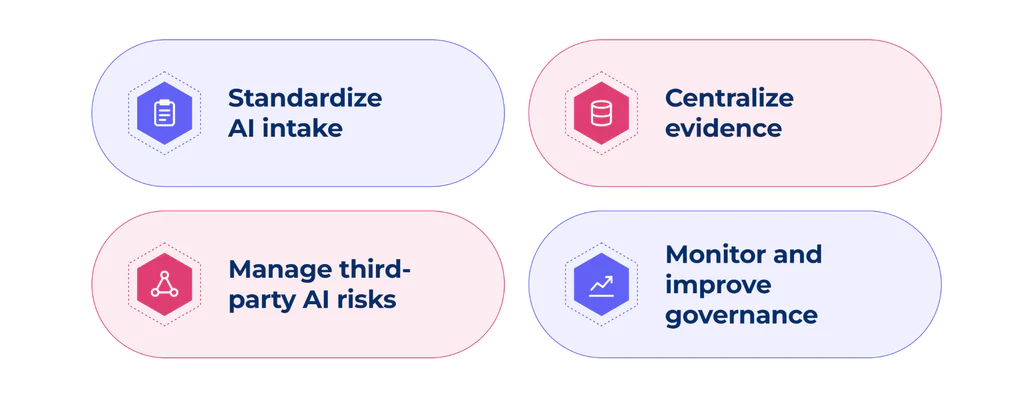
As AI adoption grows across teams and third-party vendors, governance processes must scale without slowing down operations. Standardized workflows, centralized oversight, and continuous monitoring help organizations manage increasing complexity while maintaining accountability. Here are the key AI governance best practices for scaling effectively:
Standardize AI intake
Establish a consistent intake process for all AI use cases, with review requirements adjusted according to risk level. This helps teams maintain consistent documentation, streamline approvals, and apply governance requirements across the organization. This is particularly important for generative AI governance, where employees may adopt tools outside formal procurement processes.
Centralize evidence
Maintain a centralized system for AI policies, approvals, testing records, exceptions, and ongoing reviews to improve visibility and simplify audits. This helps organizations track sensitive data usage, vendor assessments, and outstanding risks without relying on disconnected systems.
For example, 2X Solutions used Scytale to centralize its broader compliance processes, reducing internal compliance effort by 83% while gaining continuous visibility into its compliance posture.
Manage third-party AI risks
Extend AI governance requirements to external vendors providing embedded AI features, model APIs, or automated decision-making tools. Establish consistent procurement, security, and privacy reviews that assess vendor documentation, data handling practices, subprocessors, and material model changes. Organizations can also use AI TPRM tools to streamline vendor assessments, track third-party risks, and maintain ongoing oversight as vendor relationships grow.
Monitor and improve governance
Monitor key metrics such as AI inventory coverage, approval times, policy exceptions, overdue reviews, and incident trends to evaluate governance effectiveness. These insights help organizations identify gaps, improve processes, and adjust controls as AI adoption expands. Regularly updating policies and controls as regulations, business needs, and AI systems evolve makes governance part of continuous compliance rather than a one-time exercise.
Always-on GRC. Built for modern teams.
How Scytale supports AI governance
Scytale’s AI GRC platform helps compliance teams manage AI governance alongside their broader compliance requirements. Automated evidence collection, continuous monitoring, centralized policies, and cross-framework mapping help organizations maintain visibility into controls, reduce manual work, and support alignment with frameworks such as ISO 42001.
Beyond automation, dedicated GRC experts help teams translate governance principles into practical controls, prepare for certification, and address compliance requirements across multiple frameworks. Combined with a customizable Trust Center for sharing security and compliance posture with customers, Scytale helps organizations move from scattered oversight to a documented, audit-ready governance program that scales with AI adoption.
FAQs about AI governance framework
What are the key components of an AI governance framework?
The key components of an AI governance framework include policies, defined ownership, risk classification, approval workflows, control requirements, monitoring, and reporting. Strong frameworks also maintain an AI inventory, document exceptions, and set review cycles so teams manage AI use consistently as adoption expands across the organization.
Who should manage AI governance in an organization?
A cross-functional committee should oversee AI governance, with compliance typically coordinating the program day to day. Legal, security, data, procurement, and product leaders own reviews within their domains, while an executive sponsor holds final accountability. Scytale’s AI GRC platform helps these teams work from one system of record so approvals, evidence, and ownership stay aligned.
What should an AI governance policy include?
An AI governance policy should include acceptable use rules, prohibited use cases, approval requirements, documentation standards, testing expectations, human oversight rules, vendor review requirements, and incident escalation paths. It should also define who approves exceptions, how often reviews occur, and which records teams must retain.
How does ISO 42001 relate to an AI governance framework?
ISO 42001 provides a certifiable management system standard that gives an AI governance framework formal structure and external credibility. It requires organizations to document leadership oversight, risk treatment, operational controls, and continual improvement. Leading AI GRC platforms like Scytale support ISO 42001 alignment by connecting governance activities to controls, workflows, and evidence.
How often should an AI governance framework be reviewed?
An AI governance framework should be reviewed at least annually and after major changes in regulation, business strategy, vendors, or model usage. Higher-risk systems typically need more frequent reassessment to confirm that controls, approvals, and monitoring still fit their current use.