
TL;DR: ISO 42001 certification cost
- ISO 42001 certification cost depends on company size, audit scope, and how mature your AI governance program is before the audit starts.
- Most teams spend across preparation, internal staffing, tooling, external support, and the certification audit itself.
- Organizations with an existing ISO 27001 management system often spend less because they reuse governance structures, evidence, and control workflows.
- A line-by-line budget helps you avoid underestimating policy work, risk assessments, training, and surveillance audits after certification.
- Scytale’s AI GRC platform reduces ISO 42001 cost through automated evidence collection, cross-framework control mapping, and expert guidance.
AI governance budgets now face the same scrutiny that security budgets faced a few years ago. As customers ask harder questions about how vendors build, deploy, and oversee AI systems, leadership teams want a clear certification path, a realistic price range, and fewer surprises along the way.
The challenge is that ISO 42001 certification cost rarely comes from a single invoice, since total spend typically combines readiness work, internal labor, external advisors, tooling, and the audit itself. Teams that plan for each of these early are better positioned to pursue ISO 42001 certification without budget overruns. In this article, we break down realistic cost ranges, the main cost drivers, and practical ways to reduce spend.
What is ISO 42001 certification?
ISO 42001 certification is an independent, third-party confirmation that an organization operates an artificial intelligence management system (AIMS) that meets the requirements of ISO 42001.
Published in 2023, ISO 42001 is the first international management system standard for AI, setting requirements for how organizations govern AI risk, oversight, accountability, and the full AI lifecycle. Certification is issued by an accredited certification body after a two-stage audit and remains valid for three years, subject to annual surveillance audits.
Organizations pursuing certification typically include SaaS providers that embed AI into their products, AI-first companies building proprietary models, and enterprises using third-party AI in regulated environments. For many, ISO 42001 compliance is a response to buyer due diligence, as customers increasingly expect formal evidence of AI governance rather than informal internal practices. Organizations that already run ISO 27001 often treat the standard as an extension of their existing management system rather than a separate program.
AI-native GRC for how enterprise teams work today.
How much does ISO 42001 certification cost?
There is no fixed price for ISO 42001 certification, as ISO does not publish cost benchmarks and certification bodies quote based on scope, headcount, and AI complexity. Initial certification audit fees can range from around $5,000 for very small organizations to $65,000 or more for large enterprises. However, total first-year costs are often significantly higher, as they also include internal labor, consulting, documentation, tooling, and implementation work.
Certification body fees vary by provider and accreditation. Schellman, for example, quotes $20,000 to $40,000 for stage 1 and stage 2 audits for mid-sized US organizations. Total first-year costs can reach approximately $185,000 for mid-sized companies developing proprietary AI and exceed $350,000 for complex enterprise programs. Organizations that manage implementation in-house, define a focused scope, and automate evidence collection can often reduce these costs. Here are the estimated cost ranges by company size, based on certification body pricing and market estimates:
| Company profile | Initial audit fee | Estimated first-year total | Primary cost driver |
| Small (under 50 employees, third-party AI tools) | $5,000–$20,000 | Up to roughly $75,000 | Consultant support and internal hours |
| Mid-sized (50–250 employees, proprietary AI) | $20,000–$40,000 | $75,000–$185,000+ | Implementation effort and GRC tooling |
| Large enterprise (250+ employees, multiple AI systems) | $40,000–$65,000+ | $350,000+ | Scope breadth and consultant-led programs |
Get ISO 42001 Compliant
ISO 42001 cost breakdown
A line-by-line budget is the most reliable way to forecast ISO 42001 cost, as the audit invoice is typically the most visible expense but rarely the largest. Understanding each cost category helps organizations build a more accurate budget and avoid unexpected expenses. Here are the main cost categories to consider:
Internal resources and documentation
Internal labor is usually the largest hidden cost, with compliance, security, legal, product, and engineering teams spending time defining scope, documenting processes, and preparing evidence. Estimates suggest 200–400 hours of internal work for a 50-person company, equivalent to approximately $30,000–$60,000 in employee costs. Much of this work involves documentation, as ISO 42001 requires documented AI objectives, governance roles, risk and impact assessments, operating procedures, and evidence that the AIMS works in practice.
Gap assessment and readiness
Most organizations begin with a gap assessment to identify where existing practices fall short of ISO 42001 requirements and develop a remediation plan. External assessments typically cost 3,000–15,000, depending on AIMS scope and the level of expert support required. Readiness costs can increase when organizations lack documented AI oversight, incident handling, supplier reviews, or model lifecycle controls.
External consulting and training
Organizations using consultants for full implementation support typically spend 20,000–80,000, depending on AI complexity and governance maturity. Large consultancies may charge two to three times more than specialist firms. Training is another expense, with lead implementer or lead auditor courses typically costing 2,000–5,000 per person, particularly for teams developing internal audit capabilities.
Technology and automation
Compliance software helps centralize evidence, control mapping, task ownership, and audit preparation. Dedicated ISO 42001 modules are estimated to cost 7,500–10,000 annually on top of base platform subscriptions. However, GRC software can help offset these costs by automating evidence collection, reducing manual work, and limiting reliance on external consultants.
Certification audit fees
ISO 42001 certification involves two audit stages: stage 1 reviews documentation and readiness, while stage 2 assesses how the AIMS operates in practice. Fees are typically based on audit days and vary according to headcount, scope, number of locations, the organization’s AI role, and auditor travel expenses. Any nonconformities identified during the audit may also require remediation and follow-up assessments, adding to the overall cost.
Surveillance audits and recertification
ISO 42001 certification follows a three-year cycle, with surveillance audits in years two and three and full recertification at the end of the cycle. Surveillance audits typically cost 30%–40% of the initial certification fee, while recertification costs approximately 60%–70%. Organizations should also budget around $3,000–$10,000 annually for monitoring and maintenance to support continuous compliance between audits.
ISO 42001 cost categories at a glance
| Cost category | Typical range | Main cost driver |
| Internal resources | 200–400 hours (approximately $30,000–$60,000) for a 50-person company | Scope, maturity, and number of control owners |
| Gap assessment | $3,000–$15,000 | AIMS scope and use of external experts |
| Consultant support | $20,000–$80,000 | AI complexity and governance maturity |
| Training | $2,000–$5,000 per person | Number of lead implementers or auditors |
| GRC software (ISO 42001 module) | $7,500–$10,000 per year | Platform choice and integration depth |
| Certification audit | $5,000–$40,000+ | Audit days, headcount, and scope |
| Surveillance audits | 30%–40% of the initial audit fee per year | Initial audit cost and scope changes |
| Recertification (year three) | 60%–70% of the initial audit fee | Scope and control changes since certification |
Factors that affect your ISO 42001 cost
Two organizations with similar headcount can receive very different ISO 42001 certification quotes. Costs depend on existing governance processes, the scope of the AIMS, and how the organization develops or uses AI. Here are the main factors that influence the total cost:
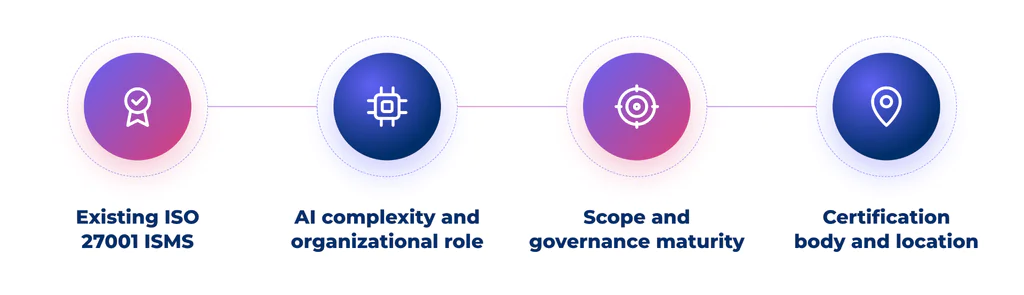
1. An existing ISO 27001 ISMS
Organizations with an existing ISO 27001 ISMS can reduce implementation costs by reusing established governance processes, including document control, internal audits, management reviews, and corrective actions. Combining ISO 27001 and ISO 42001 audits with the same certification body can also help reduce costs compared to conducting separate audits.
2. AI complexity and organizational role
Organizations developing proprietary AI models or using AI in high-risk decisions generally face more extensive governance requirements than those relying on AI third-party tools. Whether an organization develops, provides, or uses AI also determines which Annex A controls are applicable and how much evidence auditors need to review.
3. Scope and governance maturity
A narrow scope covering one AI system or product line typically costs less than one spanning multiple systems, business units, or jurisdictions. However, expanding the scope later may require additional assessments and fees. Governance maturity also affects costs, as organizations with established AI risk management, approval processes, and oversight generally need less remediation than those relying on informal workflows.
4. Certification body and location
Certification fees vary depending on the provider’s accreditation, reputation, auditor availability, and travel requirements. While comparing quotes can help reduce costs, unusually low fees deserve scrutiny, as certification from a body without recognized accreditation may not meet enterprise customer expectations.
Streamline GRC workflows with no blind spots.
How to reduce ISO 42001 certification costs
The lowest-cost path to certification typically comes from better preparation rather than a cheaper audit quote. Organizations that define scope early, assign owners before documentation begins, and close obvious gaps before the auditor arrives avoid the most expensive rework. Here are the most effective ways to reduce cost without risking the audit outcome:
Leverage multi-framework compliance
Organizations managing multiple compliance frameworks can reduce costs by reusing existing policies, risk assessments, audit processes, and evidence wherever requirements overlap. Cross-framework control mapping helps teams avoid duplicate work and streamline compliance across standards like ISO 27001, SOC 2, GDPR, HIPAA, and ISO 42001.
Scope deliberately
Start with the AI systems, teams, and processes that matter most to customers and carry the highest risk exposure. A focused scope reduces preparation work and audit days, while planning for future expansion helps avoid unexpected costs.
Automate evidence collection early
Manual evidence collection adds costs during both certification preparation and ongoing surveillance audits. Automation pulls records directly from source systems, keeps evidence current between audits, and helps reduce the time spent preparing for certification.
Automation can also simplify certification across other frameworks. For example, AstrisNexus, a Netherlands-based AI startup, achieved ISO 27001 certification in four months with Scytale, without a dedicated security or compliance employee.
Run a readiness review before the audit
A readiness review costs less than remediating nonconformities during the certification window. Working through an ISO 42001 checklist helps teams confirm that policies match actual practice, since auditors look for operational evidence rather than polished documents alone.
Compare accredited certification bodies
Requesting quotes from several accredited bodies helps teams compare audit days, included fees, and travel costs. Selecting a body that can audit multiple frameworks together can also reduce total audit time across the ISO 42001 certification process.


How Scytale simplifies ISO 42001
Scytale’s AI GRC platform reduces the cost and effort of ISO 42001 certification by centralizing AIMS controls, policies, risk assessments, and evidence in a single workspace. Automated evidence collection pulls records directly from cloud, HR, ticketing, and engineering systems, while continuous monitoring flags control gaps before they become audit findings. For organizations extending an existing ISO 27001 ISMS into AI governance, cross-framework mapping links shared controls across both standards, so teams reuse existing work rather than rebuilding it.
Beyond ISO 42001, Scytale supports multi-framework management across SOC 2, ISO 27001, GDPR, HIPAA, and SOX ITGC, while AI agents review evidence and identify gaps on an ongoing basis. Dedicated GRC experts guide teams through scoping, gap assessment, remediation, and auditor coordination, and a customizable Trust Center makes it simple to share certification status with customers. The result is a more predictable budget, fewer surprises at stage 2, and a scalable path to maintaining certification through surveillance and recertification.
FAQs about ISO 42001 certification cost
What should you budget for ISO 42001 certification beyond the audit fee?
You should budget for internal labor, readiness support, documentation work, tooling, and ongoing surveillance audits beyond the audit fee. The audit invoice is only one part of the total, and teams often spend just as much preparing evidence, assigning owners, and closing gaps before the certification review.
How long does ISO 42001 certification take?
ISO 42001 certification timelines vary depending on an organization’s AI complexity, governance maturity, and existing management systems. Organizations using AI GRC platforms like Scytale can streamline preparation by automating evidence collection, control tracking, and gap identification.
Is ISO 42001 cheaper if you already have ISO 27001?
Yes, an existing ISO 27001 ISMS typically reduces ISO 42001 cost because document control, internal audits, management reviews, and corrective action processes already exist. Organizations can also combine both audits with the same certification body, which usually costs less than running them separately.
What are the ongoing costs after ISO 42001 certification?
Ongoing costs after ISO 42001 certification include annual surveillance audits, internal audits, training updates, management reviews, and evidence maintenance. Scytale’s AI GRC platform helps reduce this recurring effort by keeping evidence, controls, and ownership current between audits.
Is ISO 42001 certification mandatory?
No, ISO 42001 certification is voluntary. Organizations typically pursue it to meet customer due diligence requirements, demonstrate responsible AI governance, and support readiness for regulations such as the EU AI Act, although certification does not replace regulatory obligations.