


TL;DR: Compliance risk management
- Compliance risk management identifies, assesses, and reduces the risk of breaking laws, standards, and internal policies.
- A strong compliance risk management program connects policies, controls, ownership, training, and remediation into one operating system.
- The compliance risk management process works best when teams document each step with clear artifacts such as risk registers and control matrices.
- Compliance risk management focuses on legal and regulatory exposure, while broader risk management covers the full business risk picture.
- Scytale’s AI GRC platform helps teams replace manual tracking with automated evidence collection, continuous monitoring, and audit-ready reporting.
Managing compliance risk is becoming more complex as regulations, security requirements, vendor relationships, and customer expectations change. Without a clear approach, organizations can struggle to identify their biggest risks, control gaps, and priorities.
A strong compliance risk management program supports a broader governance, risk and compliance (GRC) strategy by providing a structured way to manage changing obligations and exposure. This helps teams reduce exposure and stay prepared as the business and its compliance obligations evolve. In this article, we’ll explain what compliance risk management is, how the process works, its key components and benefits, common challenges, and best practices for building an effective program.
What is compliance risk management?
Compliance risk management is the proactive, systematic process of identifying, assessing, and reducing the risks that arise when an organization fails to meet legal, regulatory, contractual, industry, or internal policy requirements.
It goes beyond simply following compliance requirements such as SOC 2, ISO 27001, GDPR, and HIPAA. Compliance risk management applies a risk-based approach by evaluating what could go wrong, how likely noncompliance is, and the potential impact on the business.
This helps organizations prioritize the most significant compliance gaps and put the right controls in place before issues lead to audit findings, regulatory penalties, security incidents, or loss of customer trust. A formal program is particularly important for regulated organizations, SaaS companies managing multiple frameworks, and businesses handling sensitive customer data. Conducting a compliance risk assessment provides a structured way to identify, rank, and address these risks based on their level of exposure.
Streamline GRC workflows with seamless automation.
Key components of a compliance risk management program
An effective compliance risk management program needs more than a process for assessing individual risks. It also requires the right structure, documentation, oversight, and responsibilities to support compliance across the organization. Here are the key components to include:
Risk identification and exposure mapping
Risk identification and exposure mapping gives teams a clear view of where compliance exposure sits across the organization. Maintaining this view helps ensure new systems, vendors, business activities, and requirements are incorporated into the program. For example, a SaaS company may track GDPR exposure across product, HR, customer support, and third-party vendor processes.
Documented policies and procedures
Policies and procedures turn compliance expectations into practical guidance employees can follow. They should clearly define required actions, approvals, review schedules, and escalation paths for relevant activities. For example, an access control policy may specify who approves privileged access, how frequently permissions are reviewed, and when access must be removed.
Continuous monitoring and control testing
Ongoing monitoring provides visibility into whether controls continue to operate effectively as the business changes. Testing can cover both technical safeguards and operational processes, helping teams spot performance issues outside formal assessment periods. For example, teams may track MFA enforcement continuously while conducting scheduled user access reviews.
Employee training and awareness
Training helps employees understand how compliance requirements apply to their specific responsibilities. Programs should focus on practical situations employees are likely to encounter rather than relying only on broad compliance education. For example, customer support teams may receive privacy training on handling data subject requests and sensitive customer information.
Clear risk ownership and accountability
Clear ownership prevents compliance responsibilities from becoming shared in theory but owned by no one in practice. Each relevant area should have designated owners with the authority and context needed to make decisions and escalate concerns. For example, security may own endpoint encryption controls while legal oversees compliance requirements within customer contracts.
Incident response and remediation workflows
Defined workflows establish what happens when a compliance issue, control failure, or exception is discovered. They should set expectations for investigation, escalation, corrective action, documentation, and closure. For example, a failed vendor assessment may trigger a remediation task with an assigned owner, deadline, required actions, and approval process.
Always-on GRC. Built for modern teams.
The compliance risk management process: 5 steps
The compliance risk management process helps organizations identify, assess, manage, and monitor compliance risks. It provides a consistent way to prioritize risks, put the right controls in place, and track changes over time. Here are the five key steps in the compliance risk management process:
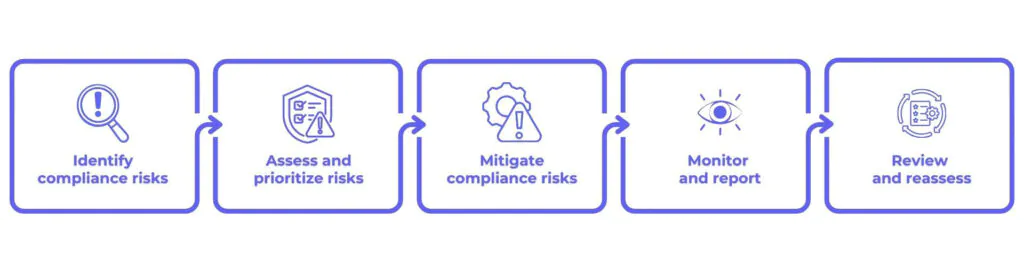
Step 1: Identify compliance risks
Start by identifying the laws, regulations, industry frameworks, contractual requirements, and internal policies that apply to your organization. Consider your business model, operating markets, customer commitments, data flows, systems, vendors, and the types of sensitive information you handle.
Then, map those requirements to the processes, systems, data, and teams they affect to uncover potential compliance risks. The main output should be a requirements inventory or risk universe that provides a clear view of your obligations and exposure. Connecting this inventory to a broader compliance risk management strategy helps ensure priorities reflect actual business risk.
Step 2: Assess and prioritize risks
Assess each identified risk based on its likelihood and potential business impact, such as regulatory penalties, failed audits, security incidents, operational disruption, lost certifications, or damage to customer trust. Combining likelihood and impact produces an inherent risk rating, helping teams focus resources on the most significant risks rather than treating every gap equally.
Document the results in a risk register that includes each risk, its score, assessment rationale, priority, and owner. Organizations already using GRC risk management should align their scoring methods so compliance risks can be evaluated consistently alongside other organizational risks.
Step 3: Mitigate compliance risks
Determine how priority risks should be addressed based on their severity and the organization’s risk tolerance. This may involve implementing new controls, strengthening existing safeguards, updating policies or processes, providing employee training, or introducing additional technical protections.
The goal is to reduce exposure to an acceptable residual risk level rather than eliminate every risk entirely. Create a control matrix connecting each risk to the controls used to manage it, and turn identified gaps into remediation plans or tickets with clear actions, owners, deadlines, and expected outcomes.
Step 4: Monitor and report
Compliance risks and controls can change as systems, employees, vendors, and business processes evolve. Regular monitoring and control testing help teams identify failures or gaps earlier instead of relying solely on annual audits or point-in-time assessments.
Track control performance, exceptions, and remediation progress through control test results, compliance dashboards, exception logs, and status reports. These outputs give compliance teams and leadership a current view of where controls are working, where issues remain, and which remediation activities require attention.
Step 5: Review and reassess
Compliance risk management is an ongoing process because your risk profile changes as the business evolves. Entering new markets, launching products, onboarding vendors, changing infrastructure, or adopting additional frameworks can introduce new requirements or change the severity of existing risks.
Reassess risks regularly and after significant regulatory or operational changes to confirm controls remain appropriate and remediation efforts have reduced exposure as expected. Update the risk register with revised scores, new or closed risks, remediation progress, and changes to controls or ownership. Vendor changes may also trigger reassessment under a third-party risk management policy.
Compliance risk management vs. risk management: What’s the difference?
Compliance risk management and broader risk management use many of the same methods, including risk registers, scoring models, controls, and reporting. The main difference is scope: compliance risk management focuses specifically on risks related to legal, regulatory, contractual, and internal policy obligations, while broader risk management considers risks across the entire organization.
Compliance risk management is therefore a subset of the wider risk management discipline. For example, it may address the risk of failing GDPR requirements, maintaining inadequate security controls for SOC 2, or breaching contractual obligations. Enterprise risk management (ERM), by comparison, also covers financial, strategic, operational, reputational, technology, and market risks that could affect business objectives.
| Area | Compliance risk management | Risk management |
| Focus | Legal, regulatory, contractual, and policy compliance risks | Financial, strategic, operational, reputational, and compliance risks |
| Scope | Specific obligations, requirements, and related controls | Enterprise-wide risks across business functions and objectives |
| Primary drivers | Laws, regulations, standards, contracts, and internal policies | Business objectives, performance, resilience, and market conditions |
| Typical owner | Compliance, legal, privacy, security, or GRC teams | Risk management function, executive leadership, or CFO |
AI-native GRC for how teams work today.
Benefits and best practices of compliance risk management
Effective compliance risk management helps organizations manage exposure more proactively while improving visibility and accountability across the business. These benefits depend on how consistently the compliance program is structured and maintained. Here are the key benefits and best practices of compliance risk management:
Benefits of compliance risk management
- Reduced legal and financial exposure: Identifying control gaps, policy failures, and emerging risks earlier gives teams more time to address them before they result in regulatory penalties, contractual breaches, audit findings, or other costly issues.
- Faster audits and certifications: Keeping controls, evidence, risk assessments, and remediation records organized throughout the year reduces last-minute evidence collection and makes it easier to demonstrate compliance to auditors.
- Stronger customer and investor trust: A structured, repeatable approach shows customers, investors, and other stakeholders that compliance risks are actively identified, monitored, and addressed rather than managed reactively.
- Better cross-department visibility: A centralized view of compliance risk helps legal, security, HR, procurement, and operations understand their responsibilities and work from the same information. Leadership also gains clearer insight into high-priority risks and remediation progress.
Best practices for compliance risk management
- Build a cross-functional compliance team: Compliance risk rarely belongs to a single department. Involve legal, security, IT, HR, procurement, and other relevant teams, with clear ownership for individual risks, controls, and remediation activities.
- Use recognized frameworks as a baseline: Frameworks and standards such as SOC 2, ISO 27001, and NIST provide established control structures that teams can use to define and assess risk rather than building criteria from scratch.
- Automate evidence collection and monitoring: Replace manual spreadsheets and periodic evidence gathering with continuous compliance workflows that collect evidence, monitor controls, and flag potential gaps throughout the year. This reduces manual work while improving visibility between audits.
- Keep leadership involved: Regularly report significant risks, control gaps, and remediation progress to senior leadership and, where appropriate, the board. This helps ensure funding, priorities, and risk acceptance decisions reflect their potential business impact.
Common challenges in compliance risk management
Compliance risk management comes with several challenges that can make it difficult to maintain visibility and stay on top of requirements. As organizations grow and compliance responsibilities increase, these challenges can become harder to manage. Here are the most common challenges in compliance risk management:
1. Constantly evolving regulations
Laws, standards, and regulatory requirements change across jurisdictions, making it difficult to keep controls and policies aligned. Missing an update can leave outdated controls in place and increase the risk of noncompliance.
2. Manual and spreadsheet-based tracking
Spreadsheets may work for smaller programs but become difficult to maintain as risks, controls, frameworks, and owners increase. Manual tracking can lead to outdated evidence, missed tasks, and control failures going undetected between audit cycles.
3. Growing third-party and vendor risk
Organizations rely on more vendors and SaaS providers, increasing the importance of third-party security and compliance. Vendor due diligence can also create new requirements for companies that need to demonstrate their own security posture. Berlitz, for example, worked with Scytale to achieve ISO 27001 certification in response to these due diligence requirements.
4. Fragmented compliance data
Risk information often sits across spreadsheets, ticketing systems, documents, and separate security tools. This makes it difficult for compliance teams and leadership to understand overall risk posture, identify priorities, and track remediation progress.



How Scytale simplifies compliance risk management
Scytale simplifies compliance risk management with automated evidence collection, continuous control monitoring, and centralized visibility across your compliance program. Teams can track risk and compliance status across SOC 2, ISO 27001, GDPR, HIPAA, and other frameworks from a single dashboard, helping them identify control gaps earlier and reduce repetitive manual work.
Built-in risk register and assessment tools support the compliance risk management process from identification and assessment through mitigation and ongoing monitoring. Scytale also keeps evidence, controls, remediation activities, and reporting audit-ready, while dedicated GRC experts provide hands-on guidance to help teams address gaps and navigate compliance requirements more efficiently.
FAQs about compliance risk management
When does an organization need formal compliance risk management?
An organization needs formal compliance risk management when it handles sensitive data, operates under multiple frameworks, or faces meaningful regulatory and contractual exposure. It becomes especially important as obligations spread across teams, systems, and vendors, making informal tracking too risky and inconsistent.
How does compliance risk management differ from enterprise risk management?
Compliance risk management focuses on legal, regulatory, contractual, and policy exposure. Enterprise risk management covers a wider set of business risks, including financial, strategic, operational, and reputational issues. Compliance risk management usually sits inside the broader ERM structure, with narrower scope and more direct ties to external obligations.
Who is responsible for compliance risk management in an organization?
Compliance risk management is typically led by compliance, legal, privacy, or security teams, but responsibility is shared across the organization. Business leaders, IT, HR, procurement, and executives all play a role in identifying and managing risks within their areas. Leading AI GRC platforms like Scytale help coordinate this work by centralizing risks, controls, evidence, ownership, and remediation in one place.
What is a compliance risk assessment?
A compliance risk assessment is the structured review your team uses to identify obligations, evaluate exposure, and rank risks by likelihood and impact. It usually produces a risk register, scoring rationale, and mitigation plan. Scytale’s AI GRC platform helps teams run this process with built-in assessment workflows and centralized reporting.
How often should a compliance risk assessment be performed?
Compliance risk assessments should be performed regularly and whenever significant business or regulatory changes occur. Reassess when you add vendors, enter new markets, launch products, change systems, or adopt new frameworks so your risk register reflects current operations.
