


TL;DR: Inherent risk vs residual risk
- Inherent risk measures the baseline level of risk associated with a business activity before additional controls are applied.
- Residual risk measures the risk that remains after controls and mitigation measures are in place.
- The gap between the two demonstrates how effectively controls reduce risk and where additional mitigation may be needed.
- Tracking both scores supports better risk management, stronger decision-making, and compliance across multiple frameworks.
- Scytale’s leading AI GRC platform automates risk management by centralizing risk assessments, controls, evidence, and continuous monitoring in one platform.
Every organization faces risk, and managing it effectively starts with understanding where that risk begins and how much remains after controls are in place. Measuring both inherent and residual risk helps organizations prioritize security investments, evaluate control effectiveness, and demonstrate that risks are being managed appropriately across the business. Together, these two measurements provide a clearer picture of an organization’s overall risk posture, helping security and compliance teams make informed decisions, allocate resources effectively, and meet regulatory expectations.
In this article, we’ll explore the differences between inherent risk and residual risk, why they matter for compliance, and how Scytale simplifies compliance risk management.
What is inherent risk?
Inherent risk is the level of risk associated with a business activity before evaluating the effectiveness of additional controls. It represents the exposure created by the nature of your operations, the data you handle, and the systems your organization depends on. Understanding inherent risk establishes the starting point for every risk assessment and provides the baseline for evaluating whether your controls are effective.
A common misconception is that inherent risk assumes no controls exist at all. In practice, it reflects the risk that exists under normal operating conditions, taking into account baseline controls that are already part of the environment but before additional safeguards reduce the risk further. This aligns with the Factor Analysis of Information Risk (FAIR) framework, which defines inherent risk as the current level of risk given existing baseline controls rather than a hypothetical environment with no protections.
Assessing inherent risk helps organizations prioritize where to invest in security risk management. Activities with higher inherent risk typically require stronger controls and closer monitoring, while lower-risk activities may need fewer safeguards. Measuring inherent risk also creates the benchmark for evaluating residual risk, making it easier to assess control effectiveness and demonstrate meaningful risk reduction over time.
What is residual risk?
Residual risk in security is the level of risk that remains after controls and mitigation measures have been implemented. It reflects the exposure an organization continues to face despite its security controls and risk management strategy. The goal is not to eliminate residual risk entirely, but to reduce it to a level that falls within the organization’s defined risk appetite.
Residual risk can never be zero. Even well-designed controls leave some exposure because threats evolve, systems change, vendors introduce new dependencies, and human error remains a constant factor. Residual risk is also dynamic, changing over time as new technologies are adopted, the threat landscape shifts, existing controls weaken, or compliance requirements become more demanding. For that reason, organizations should continuously monitor residual risk rather than treating it as a one-time assessment.
Residual risk is not solely the responsibility of IT or security teams. Weak vendor controls, failed access reviews, ineffective change management, or poor data handling practices in one part of the business can create organization-wide risk if left unaddressed. Continuously measuring residual risk helps organizations assess whether controls remain effective, identify where additional risk mitigation is needed, and demonstrate that risk is being managed within acceptable levels over time.
Streamline GRC workflows with no blind spots.
Inherent risk vs residual risk: key differences
While inherent risk and residual risk are closely related, they measure different stages of the risk management process and serve distinct purposes. Here are some of the key differences between the two:
Definition
Inherent risk is the level of risk associated with a business activity before additional controls or mitigation measures are applied, while residual risk is the exposure that remains after those controls are in place. Together, they show both the starting level of risk and the effectiveness of the organization’s risk reduction efforts. Understanding the relationship between the two helps organizations measure how effectively their controls reduce risk.
When it is assessed
Inherent risk is assessed before evaluating the impact of additional controls, helping organizations understand their initial level of exposure. Residual risk is measured after controls have been implemented to determine how much risk remains. Both should be reassessed regularly as business operations, technologies, threats, and compliance requirements evolve.
What it measures
Inherent risk measures the exposure created by the nature of the business, the data it handles, and the systems it relies on. Residual risk measures the remaining exposure after security, operational, and compliance controls have reduced that risk. Comparing both scores helps organizations measure control effectiveness and identify where additional mitigation may be needed.
How it is used in decision-making
Inherent risk helps organizations prioritize where controls, resources, and security investments are needed most. Residual risk helps determine whether existing controls are sufficient or whether additional mitigation is required to stay within the organization’s risk appetite. Together, they support more informed decisions around remediation, budgeting, and ongoing risk management.
Who owns it
Inherent and residual risk are shared responsibilities across the organization rather than the sole responsibility of security or compliance teams. While risk and security teams typically lead assessments, business leaders, control owners, IT, legal, and operational teams all influence both risk levels and control effectiveness. Effective Governance, Risk, and Compliance (GRC) programs assign clear ownership while treating risk management as a shared organizational responsibility.
Why the gap matters
The difference between inherent risk and residual risk demonstrates whether controls are effectively reducing exposure. A widening gap generally indicates that controls are working because residual risk decreases while inherent risk remains tied to the underlying business activity, whereas a narrowing gap may signal ineffective controls or emerging threats. A stable gap may reflect either a mature control environment or a program that has stopped reassessing risk, making continuous monitoring essential.
Many organizations treat these scores as audit artifacts rather than living metrics. As a result, they fail to inform remediation priorities, security investments, and ongoing risk management decisions.
Comparing Inherent Risk and Residual Risk
| Attribute | Inherent Risk | Residual Risk |
| Definition | Risk before additional controls | Risk remaining after controls |
| When assessed | Before additional controls are evaluated | After controls are implemented |
| Measures | Initial exposure | Remaining exposure |
| Decision-making | Prioritizes where controls are needed | Evaluates whether controls are effective |
| Ownership | Shared across the organization | Shared across the organization |
AI-native GRC for how teams work today.
Examples of inherent risk and residual risk
The difference between inherent risk and residual risk is easiest to understand through real-world scenarios. The following examples show how organizations reduce risk through effective controls while recognizing that some level of residual risk always remains.
1. Data loss or mishandling of sensitive customer data
Inherent risk: High. A SaaS company storing sensitive customer data in cloud environments faces significant exposure because a breach could result in financial loss, regulatory penalties, and reputational damage.
Residual risk: Medium. After implementing access controls, encryption, and continuous monitoring, the likelihood of unauthorized access is significantly reduced. However, some exposure remains due to evolving cyber threats, human error, and cloud infrastructure dependencies.
2. Unauthorized user access
Inherent risk: High. Organizations with large numbers of employees and contractors face elevated risk because excessive or inappropriate access increases the likelihood of account compromise, misuse, or accidental data exposure.
Residual risk: Low to medium. Multi-factor authentication (MFA), role-based access controls (RBAC), and regular user access reviews significantly reduce the risk of unauthorized access. Residual risk remains because credentials can still be compromised and permissions may change over time.
3. Third-party vendor breach
Inherent risk: High. Vendors with access to critical systems or sensitive data introduce risk because their security practices directly affect your organization’s exposure.
Residual risk: Medium. Vendor risk assessments, contractual security requirements, SLA enforcement, and continuous vendor monitoring reduce the likelihood and impact of a third-party incident. Even with these controls, organizations remain dependent on their vendors’ security posture.
4. Email phishing
Inherent risk: High. Every employee is a potential target for phishing attacks, making email one of the most common entry points for cyber threats.
Residual risk: Medium. Security awareness training, email filtering, and phishing detection tools significantly reduce successful attacks, but they cannot eliminate human error or increasingly sophisticated phishing techniques.
How to assess and manage inherent and residual risk
Risk scoring only works when teams understand both the starting exposure and the risk that remains after controls are applied. Whether performed manually or with risk management platforms, the process follows the same core steps. Here are the four key steps to calculate and manage inherent and residual risk:
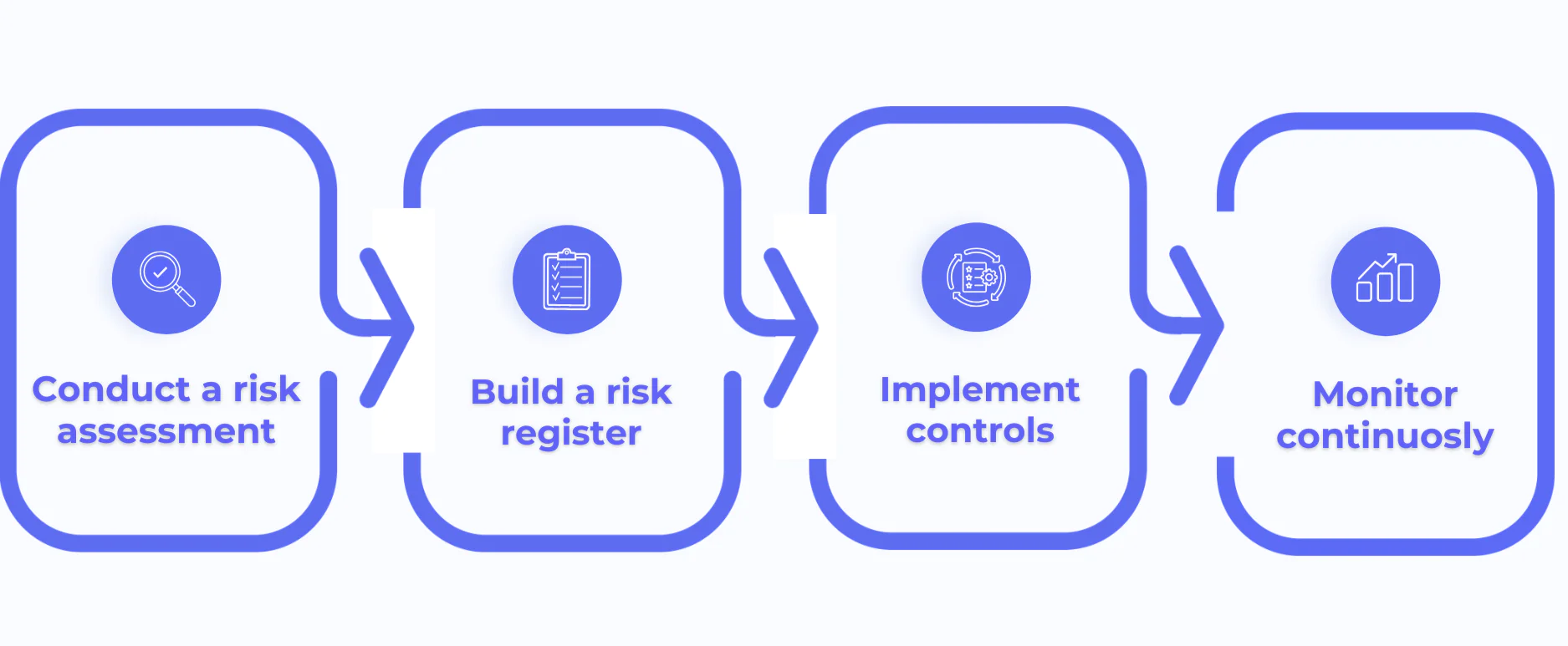
Step 1: Conduct a risk assessment
Start by inventorying your information assets, identifying who has access, and mapping relevant threat scenarios to each asset. Rate each scenario by likelihood and impact, then calculate the inherent risk score before considering the effect of enhanced controls.
This first score gives your team a clear baseline for decision-making. It also prevents teams from understating risk simply because they assume existing controls are working without recent validation.
Step 2: Build a risk register
Document every identified risk in a central risk register. Each record should include a risk description, inherent risk score, assigned owner, planned or existing controls, and the residual risk score after controls are applied.
Capturing both scores is essential for meaningful gap analysis. If teams only record the post-control score, leadership loses visibility into how much risk the controls are actually reducing.
Step 3: Implement controls
Prioritize controls for the highest inherent risk items first, since these create the greatest exposure if left untreated. Once controls are implemented, recalculate the residual risk score and document the delta between inherent and residual risk.
Validation is just as important as implementation. If a control exists on paper but does not operate effectively, the residual risk score should remain high until evidence proves the control reduces the threat.
Step 4: Monitor continuously
Inherent and residual risk are not static. Threats evolve, controls degrade, vendors change, and business processes shift, which means risk scores need to be reviewed continuously rather than updated once a quarter.
AI compliance platforms help teams track risk, control performance, and score changes in real time. This also reduces a common pitfall: gaming residual risk scores to avoid remediation work. When residual risk is understated, the gap becomes unreliable, leadership decisions are based on flawed data, and risk management becomes a reporting exercise instead of an operating discipline.
Always-on GRC. Built for modern teams.
Inherent and residual risk across compliance frameworks
Inherent and residual risk are central to most compliance frameworks and support cross-framework management by allowing organizations to map risks, controls, and evidence across multiple standards. Here’s how some of the most widely adopted frameworks apply this model:
SOC 2
The SOC 2 Trust Services Criteria require organizations to perform risk assessments and demonstrate that controls effectively mitigate identified risks. Comparing inherent and residual risk provides a practical way to show how controls reduce exposure and support continuous risk management over time.
ISO 27001
ISO 27001 explicitly requires organizations to identify, assess, and treat risk. Clauses 6.1 and 6.2 require organizations to evaluate inherent risk, implement appropriate controls, assess residual risk against acceptable thresholds, and regularly review both as business conditions evolve.
HIPAA
The HIPAA Security Rule requires covered entities to identify threats and vulnerabilities that could affect electronic protected health information (ePHI). Organizations must then implement administrative, physical, and technical safeguards to reduce residual risk to a reasonable and appropriate level.
GDPR
Article 32 of the GDPR requires organizations to apply security measures based on the level of risk to personal data. Assessing inherent risk helps determine which technical and organizational measures are appropriate, while monitoring residual risk demonstrates that those measures continue to protect personal information as threats and processing activities change.
SOX ITGC
SOX ITGC requires organizations to identify risks that could impact the integrity of financial reporting and implement controls to reduce those risks. Assessing inherent risk helps prioritize critical ITGC areas such as user access, change management, IT operations, and backup and recovery, while monitoring residual risk demonstrates whether those controls continue to operate effectively over time.

How Scytale simplifies inherent and residual risk management
Scytale’s AI GRC platform helps organizations move beyond manual risk tracking by centralizing inherent and residual risk management in a single automated workspace. Teams can document risk scores, assign owners, track controls, and manage remediation activities in one place, replacing disconnected spreadsheets with a centralized risk register that stays up to date.
Since risk management is fundamental to frameworks such as SOC 2, ISO 27001, HIPAA, GDPR, SOX ITGC, and more, Scytale’s multi-framework platform lets organizations collect evidence once and map it across multiple frameworks simultaneously. AI-powered automation streamlines evidence collection, control testing, and risk management workflows, while continuous monitoring ensures residual risk scores always reflect the current state of controls rather than a point-in-time audit.
Scytale also extends the same approach to third-party risk management. Its vendor risk management module helps organizations assess and monitor inherent and residual risk across vendors, while AI agents identify compliance gaps and provide actionable recommendations. Combined with dedicated GRC expert support, organizations gain continuous visibility into their risk posture while simplifying continuous compliance across their entire GRC program.
FAQs about inherent risk vs residual risk
What is residual risk?
Residual risk is the level of risk that remains after controls and mitigation measures have been implemented. It represents the exposure an organization continues to face despite its security, operational, and compliance controls. The goal is to reduce residual risk to a level that falls within the organization’s defined risk appetite, recognizing that it can never be eliminated entirely.
What is inherent risk?
Inherent risk is the level of risk associated with a business activity before additional controls or mitigation measures are applied. It reflects the natural exposure created by an organization’s operations, data, systems, and processes. Understanding inherent risk provides the baseline for prioritizing controls and measuring how effectively they reduce risk over time.
What is the difference between inherent risk and residual risk?
The difference between inherent risk and residual risk is that inherent risk measures exposure before additional controls are applied, while residual risk measures the exposure that remains afterward. Together, they help organizations evaluate control effectiveness and determine whether additional risk treatment is needed.
Why is tracking both inherent and residual risk important for compliance?
Tracking both inherent and residual risk is essential for effective risk management compliance, as most compliance frameworks require organizations to assess, treat, and continuously monitor risk. Recording both scores demonstrates control effectiveness and supports compliance across multiple frameworks. Scytale’s AI GRC platform centralizes risk assessments, controls, and evidence to streamline the process.
How does inherent risk apply to third-party vendor management?
Inherent risk applies to third-party vendor management by measuring the baseline risk a vendor introduces before additional safeguards are implemented. After controls such as vendor assessments, contractual requirements, and continuous monitoring are applied, organizations can evaluate the remaining residual risk. Top AI GRC tools like Scytale simplifies this process by helping teams assess, monitor, and manage vendor risk from a centralized platform.
Can residual risk be zero?
No, residual risk can never be completely eliminated. Even the strongest controls cannot remove every threat because cyber risks evolve, business environments change, vendors introduce dependencies, and human error remains a factor. The objective is to reduce residual risk to a level that aligns with the organization’s defined risk appetite rather than trying to eliminate it entirely.
