

TL;DR: AI vendor risk assessment
- An AI vendor risk assessment reviews how an AI provider handles data, models, security, and compliance before your team approves the vendor.
- Standard third party risk assessment workflows often miss model training, data use, human oversight, and output reliability risks.
- A strong AI vendor questionnaire groups questions by governance, security, privacy, model operations, and legal accountability.
- Vendor risk monitoring matters after onboarding because AI vendors change models, subprocessors, and data practices over time.
- Scytale’s AI GRC platform automates vendor assessments, evidence collection, and continuous vendor monitoring in one system.
AI is becoming part of everyday business operations, from customer support and HR to engineering and security. As organizations rely on more third-party tools, they also face new risks related to data privacy, model accuracy, security, and regulatory compliance.
Traditional vendor reviews don’t always address these AI-specific risks, leaving organizations with limited visibility into how vendors develop, deploy, and manage their AI systems. A structured AI vendor risk assessment helps teams identify potential risks, make informed procurement decisions, and maintain oversight as vendor relationships evolve. In this article, we explain how to assess AI vendors step by step, which questions to ask, and how to monitor risks over time.
What is an AI vendor risk assessment?
An AI vendor risk assessment is a structured review of an external provider’s AI systems, data practices, security controls, governance, and legal obligations to determine whether its use of AI fits an organization’s risk tolerance.
AI vendors now sit in almost every vendor portfolio because AI features are increasingly embedded in products that aren’t marketed as AI tools. McKinsey research found that nearly nine in ten respondents report regular use of AI in at least one business function. Many of these capabilities are delivered through help desk platforms, coding assistants, CRM add-ons, and analytics tools.
The assessment works best as part of a broader vendor risk management program rather than a one-time procurement checkpoint. Within that program, teams document AI-specific risk, assign owners, define compensating controls, and decide which vendors require enhanced oversight before and after contract signature.
Why AI vendors need a different assessment
Traditional security questionnaires focus on controls like access management, encryption, and incident response. However, assessing AI vendors requires a closer look at how their systems operate, how data is used, and whether appropriate safeguards are in place. Here are the key risks a standard security questionnaire may miss:
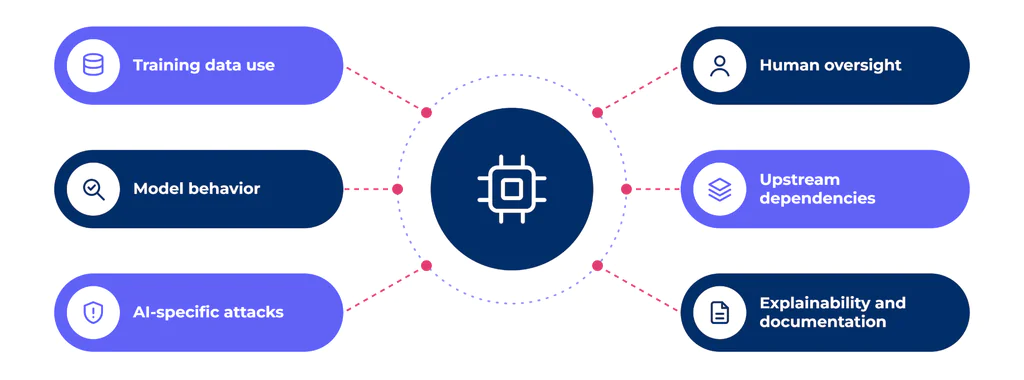
Training data use
Assess whether vendors use customer data to train, fine-tune, or improve their AI models. Understanding how data is collected, stored, and reused helps organizations identify potential risks of exposing sensitive or proprietary information.
Model behavior
Review how vendors test AI models for accuracy, bias, hallucinations, drift, and unsafe outputs. Testing should take place before deployment and after significant updates to ensure models continue performing as expected.
AI-specific attacks
Check whether vendors have security controls to protect against prompt injection, data poisoning, and other AI-specific threats. These introduce additional types of vendor risk that traditional security assessments may overlook, requiring safeguards to protect AI systems and sensitive data.
Human oversight
Determine whether human reviewers oversee sensitive AI outputs and approve high-impact decisions. Vendors should also have clear procedures for identifying errors, handling unexpected results, and escalating issues when human intervention is needed.
Upstream dependencies
Identify which foundation model providers, cloud services, and other external providers the vendor relies on. Understanding these fourth-party dependencies helps organizations assess third-party risk across the supply chain and confirm that upstream providers meet their security requirements.
Explainability and documentation
Verify that vendors can provide model documentation, testing records, and decision logs that explain how their AI systems operate. These records help organizations assess risks, demonstrate accountability, and support audits and regulatory reviews.
Streamline GRC workflows with no blind spots.
How to assess an AI vendor, step by step
A repeatable process keeps AI reviews consistent across procurement cycles and prevents each new tool from being treated as a special case. Following the same sequence from intake to approval also makes it easier to move findings into an automated vendor risk assessment workflow as volume grows. Here are the steps a vendor risk team can adopt:
Step 1: Define the AI use case and business impact
Start with the specific use case rather than the vendor’s marketing description. Document which users rely on the tool, which decisions it influences, what data it touches, and which business process would be affected if its outputs fail. This context determines how deep the rest of the review needs to go.
Step 2: Classify the data and access level
Identify the data classes the vendor will receive, generate, or store, separating public, internal, confidential, regulated, and customer data. Then confirm whether the tool connects to source systems, identity providers, or production environments, since integrations often expand exposure well beyond the data a user enters directly.
Step 3: Review governance, ownership, and policies
Establish who owns AI governance within the vendor’s organization and how leadership oversees AI risks. Effective vendor compliance management requires documented policies for acceptable use, model changes, testing, incident response, and human oversight. Vendors should also provide evidence that these policies are consistently followed.
Step 4: Assess security and privacy controls
Core security controls still apply, but the review should connect them to the AI workflow itself. Verify identity and access management, logging, encryption, environment separation, retention, and breach response, and confirm how the vendor defends against prompt injection and data poisoning.
Step 5: Examine model development and data practices
Determine which models the vendor uses, whether they are internally developed or licensed, and how outputs are tested for accuracy, bias, and drift. Review whether customer data is used for training or fine-tuning, and request model cards or equivalent documentation where available.
Step 6: Evaluate legal, compliance, and contractual terms
Review the contract with the same rigor as the technical controls. Confirm data processing terms, audit rights, subprocessor disclosures, deletion commitments, liability allocation, notice of material model changes, and any restrictions on automated decision-making or secondary data use.
Step 7: Score risk and set monitoring requirements
Assign a risk rating based on business impact and control maturity, and record any compensating controls or conditions of approval. High-risk vendors should move into AI TPRM workflows with enhanced approvals, scheduled evidence refreshes, and defined triggers for reassessment.
AI vendor risk assessment steps
| Step | What to review | Why it matters | Output |
|---|---|---|---|
| Define the use case | Business process, users, decisions, and failure impact | Sets review depth and approval path | Risk scope |
| Classify data and access | Data types, integrations, and system permissions | Shows exposure if the vendor fails | Data map |
| Review governance | Ownership, policies, and escalation paths | Tests accountability for AI risk | Governance findings |
| Assess security and privacy | Core controls, AI-specific attacks, and retention | Validates operational safeguards | Control review |
| Examine model practices | Training, validation, drift, and customer data use | Surfaces AI-specific risk | Model risk notes |
| Evaluate legal terms | DPA, subprocessors, audit rights, and liability | Aligns obligations with risk | Contract requirements |
| Score and monitor | Risk rating, compensating controls, and review cadence | Turns findings into action | Monitoring plan |
AI-native GRC for how teams work today.
AI vendor risk assessment questionnaire: key questions
An effective AI vendor questionnaire groups questions by risk area so reviewers cover every critical issue and each internal team owns a clear portion of the review. Teams already using AI TPRM tools can load these questions directly into intake and evidence request workflows, which shortens review cycles and creates a cleaner audit record. Here are the key questions to include, grouped by risk area:
AI usage and scope
Many vendors add AI features after the initial contract, so scope questions establish a baseline for future reassessment. Procurement and the business owner typically own this section. Here are the questions to ask about AI usage and scope:
- Which services provided to us use AI or machine learning, and which model types are involved?
- Is the AI customer-facing, internal only, or involved in automated decisions?
- Do you plan to introduce new AI capabilities in the next 12 months that would affect our engagement?
Data use and privacy
Data questions carry the most weight for organizations handling regulated or proprietary information. Privacy and legal teams usually lead this area. Here are the questions to ask about data use and privacy:
- Will our data, prompts, or outputs be used to train or improve your models?
- Where is our data stored and processed, who can access it, and how long is it retained?
- How do deletion requests work, and do they extend to subprocessors and model providers?
Model development and testing
Model questions reveal whether the vendor can explain and defend how its AI behaves. Security, data, or risk teams typically evaluate the responses. Here are the questions to ask about model development and testing:
- Can you provide model cards or equivalent documentation describing training data sources and limitations?
- How do you test for accuracy, bias, drift, and unsafe outputs, and which metrics do you use?
- Do humans review high-impact outputs, and how are model updates tested and communicated?
Security controls
AI services introduce attack paths that conventional penetration tests may not cover. The security team should own these questions and validate the answers against evidence. Here are the questions to ask about security controls:
- What access, encryption, segmentation, and logging controls protect the AI infrastructure?
- How do you detect and prevent prompt injection, data poisoning, and other adversarial attacks?
- Is our data logically isolated from other customers within the AI service?
Compliance, governance, and dependencies
Governance answers show whether the vendor’s AI program will hold up under regulatory and customer scrutiny. Compliance and legal teams generally review this area together. Here are the questions to ask about compliance, governance, and dependencies:
- Which AI frameworks do you align with, such as ISO 42001, NIST AI RMF, or the EU AI Act, and what evidence can you share?
- Do you retain AI decision logs, and can you produce audit trails on request?
- Which external AI providers does your service rely on, and have they been assessed under subprocessor agreements?
Monitoring AI vendors after onboarding
AI vendor risks can change after approval as models, features, subprocessors, and data practices evolve. Continuous vendor monitoring supports continuous compliance by helping organizations track these changes through regular reviews and updated evidence, with high-risk vendors requiring closer oversight. Here are the key triggers that should prompt reassessment:
- A change in the underlying model or foundation model provider
- New subprocessors or a change in data processing locations
- Expanded data use, new integrations, or new AI features
- Security incidents, outages, or public disclosures involving the vendor
- New regulatory obligations affecting the vendor or the use case
Always-on GRC. Built for modern teams.
How Scytale automates AI vendor risk management
Scytale‘s AI GRC platform brings AI vendor risk management into one system, helping teams automate vendor assessments, centralize evidence, and standardize risk scoring across the vendor portfolio. Teams can track vendor certifications and requirements across SOC 2, ISO 27001, HIPAA, GDPR, and other frameworks, which makes it easier to identify gaps without chasing documents through email threads or spreadsheets.
Scytale’s continuous monitoring helps teams maintain visibility into vendor compliance and keep evidence up to date after onboarding. Dedicated GRC experts provide hands-on guidance to refine questionnaires, interpret findings, and strengthen vendor risk processes, helping organizations stay audit-ready as their AI vendor portfolio grows.
FAQs about AI vendor risk assessment
What key risks should organizations evaluate when assessing AI vendors?
Organizations should evaluate data use, model behavior, security controls, privacy practices, human oversight, and legal accountability when assessing AI vendors. A strong review also checks training data sources, output validation, subprocessor use, retention terms, and incident response so the vendor’s AI use aligns with your risk tolerance.
How can organizations evaluate AI vendors for regulatory compliance?
Organizations evaluate AI vendors for regulatory compliance by mapping the vendor’s controls, contracts, and audit evidence to applicable requirements such as the EU AI Act, GDPR, ISO 42001, and NIST AI RMF. Reviewing relevant certifications, independent assessments, model documentation, and decision logs helps organizations verify that vendors can support their AI compliance obligations.
How often should organizations reassess their AI vendors?
Organizations should reassess their AI vendors at least annually and sooner when material changes appear. Model updates, new subprocessors, incident disclosures, expanded data use, or new integrations should trigger an earlier review because AI vendor risk shifts faster than many standard software relationships.
What tools can help automate AI vendor risk assessments?
Third-party risk management and GRC platforms automate AI vendor risk assessments by combining questionnaires, evidence collection, risk scoring, workflow routing, and monitoring in one system. Scytale’s AI GRC platform supports this process by standardizing reviews, centralizing vendor documentation, and maintaining visibility into vendor changes after onboarding.
What best practices can organizations follow to manage AI vendor risk?
Organizations should define AI use cases early, classify data before review, tailor questionnaires to AI-specific risk, score vendors consistently, and monitor changes after onboarding. Clear ownership across procurement, security, legal, and compliance prevents gaps, and leading AI GRC platforms like Scytale help teams apply these practices consistently at scale.