








TL;DR: SOC 2 compliance
- SOC 2 compliance helps organizations protect sensitive customer data, strengthen security practices, and build customer trust.
- SOC 2 is based on five Trust Services Criteria, with security being the only mandatory category.
- SOC 2 Type 1 audits assess control design, while Type 2 audits evaluate control effectiveness over time.
- SOC 2 compliance typically costs $12,000–$70,000, with timelines varying by audit type, scope, and organizational readiness.
- Scytale’s AI GRC platform simplifies SOC 2 compliance through automated evidence collection, continuous monitoring, and expert guidance.
If your business handles sensitive customer data, SOC 2 compliance is an important part of demonstrating strong security practices and building customer trust. For SaaS companies, startups, and established enterprises alike, SOC 2 helps meet growing security expectations, strengthen risk management, and support business growth.
In this article, we explain what SOC 2 compliance involves, its key requirements and benefits, and how to prepare for a successful audit.
What is SOC 2 compliance?
SOC 2 (System and Organization Controls 2) compliance refers to implementing and maintaining internal controls aligned with the AICPA’s Trust Services Criteria to protect customer data and manage security risks.
Developed by the American Institute of Certified Public Accountants (AICPA), SOC 2 is a widely recognized reporting framework that evaluates how service organizations manage information security. It is based on five Trust Services Criteria: security, availability, processing integrity, confidentiality, and privacy. These criteria help organizations establish and assess effective internal controls.
SOC 2 compliance is particularly important for SaaS companies and other service providers handling sensitive customer information. Although voluntary, it is often requested by enterprise customers during vendor security assessments. An independent SOC 2 audit provides assurance about an organization’s controls, helping businesses build trust, meet contractual requirements, and support growth.
SOC 2 attestation vs. certification: What’s the difference?
Although the terms are often used interchangeably, SOC 2 attestation and certification are not the same thing. Unlike ISO 27001, SOC 2 does not offer formal certification. Instead, organizations undergo an independent audit conducted by a licensed CPA firm and receive a SOC 2 attestation report that provides an independent opinion on their internal controls.
A SOC 2 attestation evaluates whether an organization’s controls are suitably designed and, for Type II reports, operating effectively over a specified period. While businesses often refer to being “SOC 2 certified,” the more accurate terms are SOC 2 compliant or SOC 2 attested. The resulting report provides customers and stakeholders with independent assurance about the organization’s security practices.
What are the 5 Trust Services Criteria in SOC 2 compliance?
The SOC 2 Trust Services Criteria (TSC) are five categories used to evaluate how organizations protect customer data and manage security risks. During a SOC 2 audit, an independent auditor assesses relevant controls against these criteria. Security is mandatory for every SOC 2 report, while the other four criteria are included based on the organization’s services, operations, and customer requirements. The five Trust Services Criteria are:
- Security: Protects systems and information against unauthorized access, disclosure, and other security threats.
- Availability: Ensures systems and services remain accessible and operational according to agreed commitments.
- Processing Integrity: Ensures data processing is complete, accurate, timely, and authorized.
- Confidentiality: Protects sensitive information from unauthorized access or disclosure.
- Privacy: Governs how personal information is collected, used, stored, shared, and disposed of in accordance with privacy commitments.
Who needs SOC 2 compliance?
SOC 2 compliance is particularly important for organizations that store, process, or manage sensitive customer data, especially those providing cloud-based or technology-driven services. While SOC 2 compliance is not legally mandatory, it is often required by enterprise customers and business partners as part of their security and vendor assessments. SOC 2 is especially relevant for businesses in the following industries:
- SaaS providers: Demonstrate strong security practices when storing, processing, and managing customer data.
- Cloud service providers: Protect cloud infrastructure, maintain system availability, and secure customer information.
- Fintech companies: Safeguard sensitive financial data and meet customer security expectations.
- Healthcare and health tech: Protect sensitive health information and support broader data security and regulatory compliance efforts.
Why SOC 2 matters
Cybersecurity threats affect businesses of all sizes, but startups and growing companies often face additional challenges due to limited resources, evolving infrastructure, and gaps in security awareness. A single data breach can lead to significant financial losses, operational disruptions, reputational damage, and potential legal consequences.
SOC 2 helps businesses move from reactive security measures to a more structured, risk-based approach. By establishing clear responsibilities, regularly evaluating controls, and addressing security gaps, organizations can identify weaknesses before they escalate into serious incidents. This creates a stronger foundation for managing cybersecurity risks as systems, teams, and operations become more complex.
What are the benefits of SOC 2 compliance?
Achieving SOC 2 compliance offers advantages beyond meeting security requirements. From improving operational efficiency to strengthening customer relationships, SOC 2 helps organizations build a more resilient and competitive business. Here are the key SOC 2 benefits:
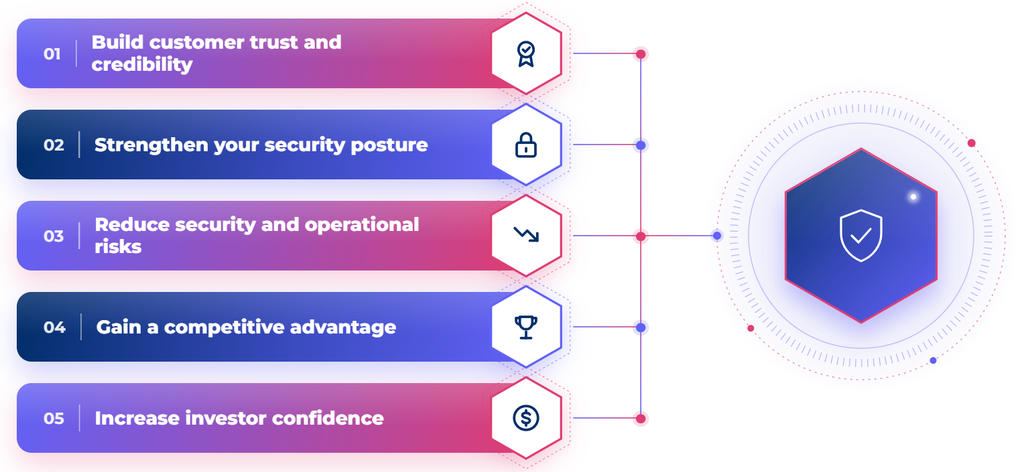
1. Build customer trust and credibility
A SOC 2 report provides independent assurance that your organization has implemented appropriate security controls. This helps strengthen customer confidence, improve retention, and demonstrate your commitment to protecting sensitive information.
2. Strengthen your security posture
SOC 2 encourages organizations to establish consistent security practices, improve internal controls, and maintain better visibility into their security posture. This supports a more structured approach to protecting systems and information.
3. Reduce security and operational risks
By regularly assessing controls and identifying weaknesses, SOC 2 supports effective risk management. It helps organizations reduce exposure to data breaches, human error, and security vulnerabilities before they lead to costly incidents.
4. Gain a competitive advantage
Many enterprise customers require a SOC 2 report before signing contracts. Having one readily available can simplify vendor security assessments, reduce procurement delays, and help businesses secure new opportunities faster.
5. Increase investor confidence
SOC 2 demonstrates that your organization takes security, governance, and operational accountability seriously. For startups and growing businesses, this can provide additional reassurance to potential investors and support fundraising discussions.
What is a SOC 2 audit?
A SOC 2 audit is an independent assessment of an organization’s internal controls, policies, and processes against the applicable AICPA Trust Services Criteria. Conducted by an independent, licensed CPA firm, the audit involves reviewing documentation, examining security controls, and evaluating evidence to determine whether the organization meets the relevant SOC 2 requirements.
There are two types of SOC 2 audits: Type 1 and Type 2. Type 1 assesses the design of controls at a specific point in time, while Type 2 also evaluates their operating effectiveness over a defined period. The table below highlights the key differences.
| Aspect | SOC 2 Type 1 | SOC 2 Type 2 |
| Focus | Design of internal controls | Design and operating effectiveness of controls |
| Assessment period | Specific point in time | Defined period, typically 3–12 months |
| Evidence reviewed | Policies, procedures, and control configurations | Evidence of controls operating throughout the review period |
| Audit duration | Generally shorter | Longer due to the observation period |
| Primary objective | Assess whether controls are suitably designed | Evaluate whether controls operate effectively over time |
Streamline GRC workflows with no blind spots.
SOC 2 Type 1 vs Type 2 reports: What’s the difference?
A SOC 2 report is a formal attestation report issued by an independent CPA firm following a SOC 2 audit. It documents the organization’s systems, internal controls, and the auditor’s findings against the applicable SOC 2 requirements. A typical SOC 2 report includes management’s assertion, a system description, the auditor’s opinion, and details of the controls assessed, such as access management, data encryption, and incident response.
Both SOC 2 Type 1 and Type 2 reports provide independent assurance, but they serve different business needs. Type 1 is often suitable for organizations beginning their compliance journey, while Type 2 provides more comprehensive evidence of control effectiveness and is generally preferred by enterprise customers. Here is how they compare:
| Aspect | SOC 2 Type 1 Report | SOC 2 Type 2 Report |
| Assurance provided | Opinion on control design at a specific date | Opinion on control design and operating effectiveness over time |
| Report contents | System description, management assertion, auditor’s opinion, and relevant controls | Same core elements, plus control tests and results |
| Level of detail | Snapshot of the control environment | Detailed assessment of control performance |
| Customer acceptance | May satisfy initial vendor security assessments | Often preferred for enterprise procurement |
| Best suited for | Organizations seeking initial assurance | Organizations demonstrating sustained control effectiveness |
| Business value | Establishes a baseline for customer security reviews | Provides stronger evidence for ongoing vendor due diligence |
SOC 1 vs. SOC 2 vs. SOC 3: Key differences
While SOC 2 focuses on information security, it is one of three main types of SOC reports. Each serves a different purpose, depending on the controls being assessed and the intended audience.
SOC 1: Financial reporting controls
A SOC 1 report evaluates controls at service organizations that may affect their customers’ financial reporting. It is particularly relevant for payroll processors, financial service providers, and other businesses whose services impact financial statements.
SOC 2: Security and data protection
A SOC 2 report assesses controls related to security, availability, processing integrity, confidentiality, and privacy. It is commonly requested by customers and business partners to evaluate a service provider’s security practices.
SOC 3: Public security assurance
A SOC 3 report covers the same Trust Services Criteria as SOC 2 but provides a less detailed, publicly shareable summary. Organizations can publish it on their websites or Trust Centers to demonstrate their commitment to security without disclosing sensitive control information.
How long does it take to get SOC 2 compliant?
The time it takes to achieve SOC 2 compliance depends on your organization’s size, security maturity, existing controls, and audit scope. A SOC 2 Type 1 audit can typically be completed within a few weeks to a few months, while Type 2 generally takes 3–12 months or longer, including the observation period. The process involves several stages, from initial gap assessments and audit preparation to evidence collection, testing, and final reporting.
Using SOC 2 compliance automation software can significantly streamline the process by automating evidence collection, monitoring controls, and identifying compliance gaps early. This reduces manual effort, helps teams prepare for audits more efficiently, and supports ongoing compliance without disrupting daily operations.
Get SOC 2 Compliant 90% Faster
How much does SOC 2 compliance cost?
The cost of SOC 2 compliance typically ranges from $12,000 to $70,000, depending on your organization’s size, security maturity, audit scope, and whether you’re pursuing Type 1 or Type 2. Expenses extend beyond external audit fees to include policy development, risk assessments, security awareness training, remediation, consulting, and ongoing compliance management. Internal resources and the time spent preparing evidence can also significantly increase the total cost.
Using an AI GRC platform can help reduce these expenses by automating evidence collection, streamlining control monitoring, and minimizing manual work. For example, cloud infrastructure company Zesty reduced its internal SOC 2 workload by 80% with Scytale, while strengthening its security controls, policies, and vendor risk management processes.
The SOC 2 compliance process in 7 steps
Achieving and maintaining SOC 2 compliance involves several key stages, from defining your audit scope to monitoring security controls. Using a SOC 2 compliance checklist can help you stay organized, identify gaps, and prepare more efficiently. Here are the seven steps to follow:
1. Choose a SOC 2 compliance partner
Working with an experienced SOC 2 compliance partner can simplify audit preparation, especially for organizations without dedicated security or compliance teams. A partner can help you understand SOC 2 requirements, identify relevant controls, and develop a clear compliance roadmap. This guidance reduces unnecessary work and helps your team prepare more efficiently.
2. Define your SOC 2 audit scope
Determine which systems, services, and Trust Services Criteria will be included in your audit, keeping in mind that Security is mandatory. Your scope should reflect your organization’s operations, security risks, and customer requirements. For Type 2 audits, you must also establish a reporting period during which your controls will be evaluated.
3. Select an independent auditor
A SOC 2 audit must be conducted by an independent, licensed CPA firm with the appropriate expertise. Choose an auditor familiar with your industry, business model, and the complexity of your systems. Compare audit methodologies, costs, timelines, and experience to find a firm that aligns with your organization’s needs.
4. Conduct a SOC 2 readiness assessment
A SOC 2 readiness assessment evaluates whether your existing security controls, policies, and processes meet the applicable Trust Services Criteria. Conducting a gap analysis helps identify weaknesses in your compliance program, including missing controls and areas requiring improvement. Address these gaps, implement necessary changes, and organize supporting evidence to strengthen your audit readiness.
5. Complete the SOC 2 audit
During the official audit, your auditor examines relevant policies, procedures, system configurations, and supporting evidence to assess your internal controls. For Type 1, the assessment focuses on control design at a specific point in time, while Type 2 also evaluates operating effectiveness over a defined period. Once the assessment is complete, the auditor issues a SOC 2 report detailing their opinion and findings.
6. Review your SOC 2 report
Your SOC 2 report provides an independent auditor’s opinion on the design of your controls and, for Type 2, their operating effectiveness against the applicable Trust Services Criteria. Review the report carefully to understand the findings, identify any control deficiencies or exceptions, and determine whether corrective action is needed. Addressing these issues helps strengthen your security practices and improve preparation for future audits.
7. Maintain continuous SOC 2 compliance
SOC 2 compliance requires ongoing attention rather than a one-time audit, with reports generally updated annually to meet customer expectations. Regularly monitor security controls, collect evidence, review access permissions, and update policies as your organization evolves. Maintaining continuous oversight helps identify risks early, reduce last-minute audit preparation, and keep your organization audit-ready throughout the year.



Streamline SOC 2 compliance with Scytale
Scytale’s AI GRC platform helps organizations achieve and maintain SOC 2 compliance through a combination of intelligent automation and expert guidance. Customized controls, automated evidence collection, user access reviews, vendor risk management, and agile audit management reduce the manual effort behind audit preparation, so your team can stay focused on growing the business.
Scytale also supports continuous compliance and multi-framework cross-mapping across SOC 2, ISO 27001, HIPAA, GDPR, and SOX ITGC, eliminating duplicate work as your compliance program grows. Combined with a customizable Trust Center and dedicated GRC experts who guide you every step of the way, Scytale helps organizations stay audit-ready year-round with greater confidence.
FAQs about SOC 2 compliance
What does SOC 2 mean?
SOC 2 stands for System and Organization Controls 2. It is an AICPA reporting framework used to assess how service organizations manage security and protect customer data. SOC 2 is based on five Trust Services Criteria: security, availability, processing integrity, confidentiality, and privacy.
Is SOC 2 mandatory?
SOC 2 is not legally mandatory, but many enterprise customers require it before approving vendors, particularly SaaS and cloud service providers. Scytale’s AI GRC platform simplifies audit preparation through automated evidence collection and continuous control monitoring.
Who needs SOC 2 compliance?
SOC 2 is particularly relevant for SaaS providers, cloud service providers, fintech companies, and other organizations that handle sensitive customer information. While SOC 2 is commonly referred to as a certification, organizations actually receive an independent attestation report demonstrating how their security controls have been assessed.
Who performs a SOC 2 audit?
A SOC 2 audit must be performed by an independent, licensed CPA firm with the appropriate auditing expertise. The auditor evaluates the organization’s internal controls against the applicable Trust Services Criteria and issues a formal report detailing their opinion and findings.
Can you fail a SOC 2 audit?
SOC 2 audits do not have a traditional pass-or-fail outcome. Instead, the auditor issues an opinion, which may be unmodified, qualified, adverse, or a disclaimer of opinion. Significant control deficiencies can result in a modified opinion, so addressing compliance gaps before the audit is essential.
How long is a SOC 2 report valid?
A SOC 2 report does not have a formal expiration date, but most customers expect a report issued within the last 12 months. Organizations therefore typically undergo annual audits to maintain current assurance, with bridge letters sometimes used to address gaps between reporting periods.
What’s the difference between SOC 2 and ISO 27001?
SOC 2 provides an independent auditor’s report on security controls, while ISO 27001 offers formal certification of an information security management system (ISMS). Both share overlapping controls, and Scytale’s AI GRC platform helps manage both frameworks through cross-mapping, reducing duplicate work.


