








TL;DR: SOC 2 audit
- A SOC 2 audit ends with an independent attestation report that customers use to assess your security controls.
- Only a licensed CPA firm can issue a SOC 2 report, so not every consultant or advisor qualifies to perform the audit.
- The right SOC 2 auditor brings relevant SaaS experience, a clear process, and practical guidance on evidence and timing.
- Audit cost depends on scope, readiness, system complexity, and whether you pursue a Type I or Type II report.
- Scytale’s AI GRC platform helps teams get audit-ready by organizing evidence, mapping controls, and reducing manual work before the auditor starts testing.
Customer due diligence often comes down to one high-stakes detail: whether the firm behind your SOC 2 audit is qualified to issue the report at all. Choosing the wrong provider costs time, creates repeat work, and can delay deals when buyers expect a valid SOC 2 report during procurement.
The rule looks simple on paper, yet selecting a firm rarely feels simple in practice. Teams need to understand who holds the authority to issue the report, which experience matters beyond a license, and how the audit process shapes cost and timing. In this article, we cover who qualifies to perform a SOC 2 audit and how to choose the right firm for your organization.
What is a SOC 2 audit?
A SOC 2 audit is an independent examination of an organization’s security controls that results in an attestation report on how effectively those controls protect customer data.
The audit is performed under the American Institute of Certified Public Accountants (AICPA) attestation framework and evaluates controls either at a single point in time for a Type I report or across a defined review period for a Type II report. Buyers request the report because security questionnaires and policy documents rarely provide the same level of independent assurance, which is why it appears so often in procurement and renewal cycles.
The audit itself focuses on evidence rather than intent. Auditors review how teams manage access, change control, monitoring, incident response, and vendor oversight against the Trust Services Criteria in scope, then document control design, testing results, exceptions, and a final opinion in a report that sales and security teams use in customer conversations.
Who can perform a SOC 2 audit?
The question of who can perform a SOC 2 audit has a clear answer, yet many teams confuse readiness partners with the firms authorized to issue the final report. Understanding this distinction is essential to ensuring your SOC 2 report meets customer and procurement requirements. Here are the key rules governing who can perform a SOC 2 audit:
Who is qualified to perform a SOC 2 audit?
Only a licensed CPA firm can issue a SOC 2 report under the AICPA attestation standards. A valid SOC 2 attestation requires an independent CPA firm to oversee the examination, evaluate the relevant controls, and issue the final report. Consultants, compliance platforms, virtual CISOs, and internal audit teams can support preparation, evidence collection, and remediation but cannot independently issue the report.
What does a SOC 2 auditor do?
A SOC 2 auditor evaluates an organization’s controls against the agreed audit scope and applicable Trust Services Criteria. This involves reviewing documentation, conducting walkthroughs, testing controls, and assessing their effectiveness before the report is issued. SOC 2 audit teams often include CPAs and IT audit specialists who work together under the licensed CPA firm’s authority.
Why is auditor independence important?
Auditor independence ensures that SOC 2 examinations provide objective and credible assessments of an organization’s security controls. The issuing CPA firm must maintain independence from the organization being audited and avoid taking on management responsibilities that could compromise its objectivity. This independent assurance gives customers greater confidence in the SOC 2 report compared to internal assessments, consultant evaluations, or self-reported security questionnaires.
Get SOC 2 Compliant 90% Faster
What qualifications should a SOC 2 auditor have?
A CPA license is the starting point, but it’s not the only qualification to consider when selecting an auditor for SOC 2 compliance. Audit quality depends heavily on industry experience, and a firm that regularly audits SaaS companies can typically navigate scoping, evidence requests, and control testing more efficiently than a generalist firm with limited technology exposure. Here are the key qualifications to look for beyond the CPA license:
Relevant SOC 2 and SaaS experience
Ask how many SOC 2 engagements the firm completes each year and what types of companies it audits. A strong answer references similar headcount, cloud architecture, customer profile, and report type, rather than broad assurance experience alone.
Technical credentials and peer review
Strong audit teams typically pair CPAs with IT audit specialists who hold credentials such as CISA or CISM, which support a deeper assessment of cloud infrastructure, identity systems, and security tooling. CPA firms that perform attestation work are also subject to AICPA peer review, so organizations can ask for the firm’s most recent peer review results as an additional quality signal.
Knowledge of control testing
Your auditor should be able to explain how the team tests access reviews, logging, change management, incident response, and vendor controls. Clear testing logic reduces confusion later, especially when teams prepare evidence across a Type II review period.
Communication and project management
Strong auditors keep requests organized and explain findings in plain language. Organizations benefit from a team that sets timelines, flags gaps early, and avoids vague evidence requests that create unnecessary back-and-forth across security, engineering, and HR.
How to choose the right SOC 2 audit firm
The right SOC 2 audit firm does more than issue a report. It keeps the engagement predictable, aligns testing with your environment, and helps teams avoid costly rework during one of the most visible trust milestones in the sales cycle. Here are the criteria to use when shortlisting and selecting a firm:
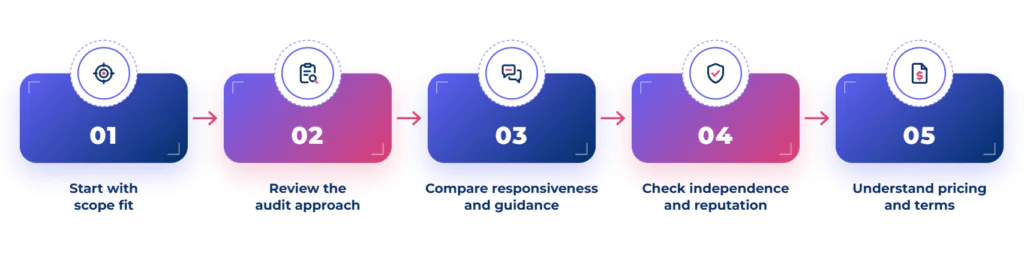
1. Start with scope fit
Shortlist firms that regularly audit companies with your product model, infrastructure, and customer expectations. If your environment includes multiple cloud services, contractors, or complex access patterns, the auditor should understand the relevant SOC 2 requirements and handle those factors without turning every issue into a custom debate. Organizations operating across several regions should also confirm whether the firm can cover every in-scope location.
2. Review the audit approach
Ask each firm how it handles scoping, walkthroughs, sampling, testing, exceptions, and report drafting. A clear methodology helps teams assign internal owners, set evidence deadlines, and plan remediation windows before the engagement begins.
3. Compare responsiveness and guidance
Audit quality shows up in communication as much as in credentials. During selection, note how quickly the firm answers questions, how specific its answers are, and whether it explains the tradeoffs between Type I and SOC 2 Type ll timing.
4. Check independence and reputation
Request references from similar companies and review sample deliverables where the firm shares them. Organizations should also confirm how the firm separates any advisory support from the final attestation, so the report holds up under customer scrutiny.
5. Understand pricing and engagement terms
Low fees often hide scope limits, additional charges, or slower turnaround. Review what the proposal includes, who performs the fieldwork, how exceptions are handled, and whether the firm supports follow-up questions after report delivery.
Key criteria for choosing a SOC 2 audit firm
| Audit firm criterion | Why it matters | What to ask |
|---|---|---|
| Licensing | Only a licensed CPA firm issues a valid SOC 2 report. | Is your firm licensed to perform SOC 2 attestation work? |
| SaaS experience | Relevant experience shortens scoping and improves testing quality. | How many SaaS SOC 2 audits did you complete in the last year? |
| Testing methodology | A defined process reduces delays and evidence confusion. | How do you handle walkthroughs, sampling, and exceptions? |
| Communication | Fast, clear responses keep internal teams aligned. | Who manages requests, and how often do you provide status updates? |
| Pricing model | Fee structure affects total audit cost and unexpected charges. | What is included in the base fee, and what triggers extra charges? |
| Post-report support | Customers often ask follow-up questions after delivery. | Do you support clarification requests after the report is issued? |
What happens during a SOC 2 audit?
Knowing the stages of a SOC 2 audit helps teams plan internal owners, evidence deadlines, and remediation time before fieldwork begins. The sequence is broadly similar across firms, although the depth of testing depends on whether the report is Type I or Type II. Here are the main stages of a SOC 2 audit:
Audit readiness and preparation
Preparation has a direct effect on speed and outcome quality. Teams that assess SOC 2 audit readiness early, with evidence centralized and control owners assigned before fieldwork, can shorten the path to audit-ready status considerably and face fewer surprises during testing.
For example, Totango used Scytale to become SOC 2 audit-ready in 2.5 weeks, a record turnaround for the company.
Scoping and audit setup
A SOC 2 audit typically starts with scope confirmation rather than testing. The auditor defines the system boundaries, applicable Trust Services Criteria, report type, review period, and control set so both sides agree on what the examination covers.
Evidence collection and testing
Next come stakeholder walkthroughs and evidence collection. The audit team reviews policies, screenshots, tickets, logs, approvals, and system settings, then tests whether controls are designed appropriately and, for a Type II report, whether they operate effectively across the full review period.
Exceptions, reporting, and the auditor’s opinion
If the auditor identifies gaps or exceptions, your team responds with context, remediation details, or additional evidence. Management also provides a formal SOC 2 management assertion regarding the system description and the suitability of control design and, for Type II reports, operating effectiveness.
After testing ends, the firm drafts the report, finalizes its opinion, and delivers the completed attestation for customer sharing. Understanding the different SOC 2 audit opinions helps teams anticipate how exceptions may affect the final report and customer trust.
How much does a SOC 2 audit cost?
SOC 2 audit fees depend on scope, report type, company size, system complexity, and readiness level. A Type II audit usually costs more than a Type I because the auditor tests how controls operate across a longer review period rather than at a single point in time.
Costs also rise when teams enter the audit with weak documentation, unclear control ownership, or unresolved gaps, since each issue adds testing time and follow-up requests. Firms typically charge more when testing covers additional systems, more Trust Services Criteria, or multiple locations.
💡 For a broader budgeting view, this guide to SOC 2 compliance cost breaks down the full program expense beyond the audit fee, including readiness work, tooling, and internal effort.



How Scytale gets you audit-ready
Audit readiness shapes the quality of your report long before the CPA firm starts testing. Scytale’s AI GRC platform helps teams centralize evidence, map controls to the Trust Services Criteria, track remediation, and maintain a clear record of how the program operates across the audit period. Automated evidence collection, continuous monitoring, and AI agents that review evidence and flag gaps reduce the manual follow-up that typically slows fieldwork, giving auditors a consistent, well-organized evidence trail from the first day of the engagement.
Scytale also supports multi-framework management, so controls built for SOC 2 can be cross-mapped to ISO 27001, GDPR, HIPAA, and SOX ITGC without duplicate work. Combined with a customizable Trust Center for sharing your security posture with buyers and dedicated GRC experts who guide teams through readiness, auditor coordination, and remediation, Scytale helps organizations enter every SOC 2 audit prepared and maintain continuous audit readiness as they scale.
FAQs about SOC 2 audits
Who is qualified to perform a SOC 2 audit?
Only a licensed CPA firm is qualified to perform a SOC 2 audit and issue the final report. Individual auditors work under that firm’s attestation authority, which gives the report formal standing with customers, procurement teams, and other third parties reviewing your security program.
Can a non-CPA perform a SOC 2 audit?
No, a non-CPA cannot issue a SOC 2 audit report. Consultants, internal teams, and platforms like Scytale support readiness, evidence collection, and remediation, yet a licensed CPA firm still performs the independent examination and signs the final attestation.
How do I choose a SOC 2 auditor?
Choose a SOC 2 auditor by checking CPA firm licensing, SaaS audit experience, testing methodology, communication style, and pricing clarity. Scytale’s AI GRC platform helps teams prepare for those conversations by organizing controls and evidence before the auditor starts formal testing.
How long does a SOC 2 audit take?
A SOC 2 audit timeline depends on readiness, scope, and report type. A Type I usually moves faster because it tests control design at a point in time, while a Type II includes an operating period and often takes several months from preparation through report delivery.
How much does a SOC 2 audit cost?
SOC 2 audit cost depends mainly on scope, environment complexity, report type, and readiness level. Firms charge more when testing covers more systems, more controls, or a longer review period, and teams often reduce total effort when Scytale helps organize evidence before fieldwork begins.


