








TL;DR: Manual vs automated SOC 2
- Manual SOC 2 compliance relies on spreadsheets, screenshots, and repeated follow-up across teams.
- Automated SOC 2 compliance connects your systems to evidence collection and monitoring workflows.
- The biggest change is not the audit itself, but the daily work required between audits.
- Some SOC 2 tasks fit automation well, while judgment-heavy reviews still need people.
- Scytale’s AI GRC platform combines automation and AI agents with expert guidance to reduce manual compliance work.
SOC 2 programs rarely fail because teams do not understand the framework. They stall because evidence collection, control checks, and audit preparation consume far more time than anyone planned, and the gap between manual and automated work shows up most clearly in daily operations.
For organizations comparing spreadsheets against SOC 2 compliance automation software, the right choice depends on scale, system complexity, and how often the environment changes. In this article, we compare both approaches and explain how to move from manual to automated SOC 2 work.
What does manual SOC 2 compliance look like?
Manual SOC 2 compliance is an approach in which teams track controls, collect evidence, and prepare for audits using spreadsheets, screenshots, and shared folders rather than connected software.
The work usually starts with a shared spreadsheet and ends with a long trail of screenshots, exports, and reminder messages. Controls are tracked in one place, evidence is stored in another, and deadlines depend on individual control owners remembering when each task comes due. Because security, IT, HR, engineering, and finance each own part of the audit, most of the time goes into coordination rather than control design, as someone has to chase evidence, confirm dates, and check that each file still matches its control.
Manual processes also create version problems. A policy update, access review, or vendor list change often leaves older files in circulation, which forces teams to recheck evidence before the auditor sees it. The result is a program built around point-in-time collection, where SOC 2 evidence collection becomes a burst of last-minute activity before each milestone rather than a steady, predictable workflow.
Streamline GRC workflows with seamless automation.
What does automated SOC 2 compliance look like?
Automated SOC 2 compliance shifts the work from manual collection to connected oversight. Organizations link cloud, identity, HR, ticketing, and security systems so the platform pulls evidence directly from the source, which changes the daily routine far more than the audit meeting itself. Here are the two main changes teams notice in day-to-day work:
Connected evidence collection
Instead of asking each department for screenshots, the platform collects configuration data, access records, and ticket histories through integrations and maps them to the relevant controls. Compliance teams then review alerts, validate exceptions, and confirm that controls still operate as intended, rather than spending their week requesting files.
Ongoing monitoring and review
AI adds another layer by reviewing evidence quality, flagging gaps, and mapping one control across related requirements. For teams working toward continuous SOC 2 compliance, automation shortens the lag between a control issue and the moment someone notices it, which matters most when the environment changes weekly rather than quarterly.
The difference is especially clear for organizations that have outgrown spreadsheets and disconnected systems, where every audit cycle once restarted the same manual collection effort.
For example, 2X Solutions replaced spreadsheets and disconnected systems with Scytale’s centralized GRC platform, reducing internal compliance effort by 83% and giving the team continuous visibility into its compliance posture.
Manual vs automated SOC 2: Side-by-side comparison
The main difference between manual and automated SOC 2 processes is the time and effort involved. Manual processes rely on periodic evidence collection and follow-ups, while automation keeps evidence and controls up to date. Auditors still test controls, but automated workflows provide clearer records and reduce last-minute requests. Here are the key differences in SOC 2 compliance across time, cost, evidence, monitoring, and audits:
Time and team effort
Manual programs consume hours across multiple teams because every control request starts a new collection cycle. Automated programs reduce repeat requests by pulling evidence from connected systems and keeping it organized by control, so most of the effort shifts to initial setup and periodic review.
Cost and resource allocation
Manual compliance often looks cheaper at first because spreadsheets and shared folders cost little. The hidden cost sits in employee time, delayed audit preparation, and the rework required when evidence expires or goes missing, while SOC 2 automation tools move spend toward a platform subscription and away from recurring manual labor.
Evidence collection and monitoring
Manual evidence collection captures a moment in time and says little about what happened between snapshots. Automated workflows support ongoing checks, helping teams spot access changes, missing approvals, or failed configurations before the audit window closes, which is particularly important during SOC 2 Type II observation periods.
Audit experience
Manual audits often involve long request lists and repeated rounds of clarification. Automated audits still require human discussion, but the supporting records generally arrive faster and with stronger traceability, which reduces back-and-forth with the auditor.
Manual vs automated SOC 2 comparison
| Approach | Time | Cost pattern | Evidence collection | Monitoring | Audit experience |
|---|---|---|---|---|---|
| Manual SOC 2 | High recurring effort across teams | Low software spend, high labor spend | Screenshots, exports, and shared folders | Periodic and reactive | More back-and-forth with auditors |
| Automated SOC 2 | Lower recurring effort after setup | Platform spend, lower manual labor | System-connected and control-mapped | Continuous and alert-driven | Cleaner records and faster responses |
AI-native GRC for how enterprise teams work today.
What can and can’t be automated in SOC 2
SOC 2 compliance tools can significantly reduce manual work, but they cannot eliminate the need for human oversight. While automation streamlines repetitive tasks such as evidence collection, continuous monitoring, and compliance reminders, people remain responsible for critical decisions, approvals, and remediation. Here’s a breakdown of what can be automated, what still requires human involvement, and where the two overlap:
Tasks that automate well
Repeatable tasks that pull cleanly from source systems are the strongest candidates for SOC 2 compliance automation, provided integrations stay healthy. Common examples include:
- Evidence collection from cloud, identity, and HR systems
- User access checks, including onboarding and offboarding records
- Ticket sampling for change management approvals
- Policy distribution and employee acknowledgment records
- Security awareness training completion tracking
- Cloud configuration monitoring and drift detection
Tasks that need human review
Risk assessments, exception handling, vendor decisions, incident analysis, and control design still require people. Audit scoping, policy approval, physical security, and executive sign-off also remain human responsibilities. A SOC 2 platform surfaces context faster, but the team still decides whether a gap matters and which action fits.
Shared ownership between automation and people
Some controls sit in the middle. Automation gathers logs, confirms timestamps, and flags anomalies, while control owners review the output, document their rationale, and approve the final record for the auditor. Vulnerability management works the same way, since a platform can integrate scanner results while remediation decisions and penetration testing still depend on people.
Where teams misjudge automation
Teams usually overestimate automation in narrative-heavy controls, such as governance, risk management, and incident response planning. A platform supports the workflow, but it does not replace management oversight, policy accountability, or the need to prove that people followed the process.
When manual compliance still makes sense
Manual compliance remains a reasonable choice when the environment is small, stable, and lightly integrated. A company with limited systems, a narrow audit scope, and a near-term customer deadline can often manage its first audit cycle without a dedicated platform.
A manual approach also suits teams that want to validate readiness before investing in software. Organizations still building their first SOC 2 compliance checklist can use a manual process to expose which controls, owners, and systems matter most.
The tradeoff appears as the company grows. More employees, more tools, and more customer security reviews generally turn a workable manual process into a recurring operational burden, and the cost of staying manual rises with every additional framework or audit.
How to move from manual to automated SOC 2
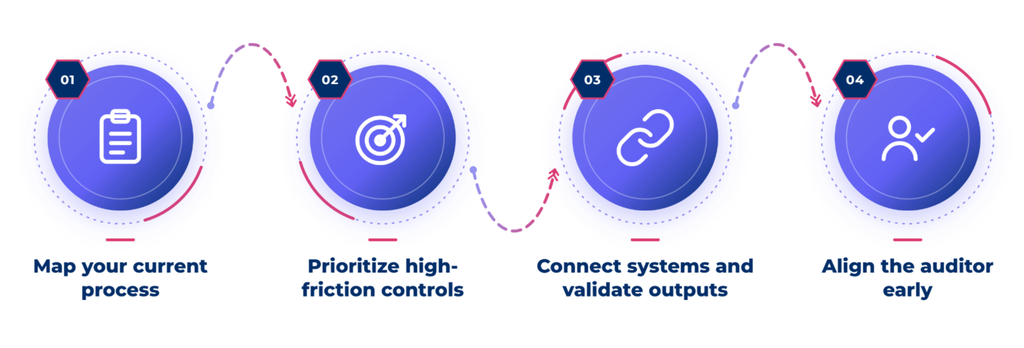
The best time to move from manual to automated SOC 2 is before the evidence backlog builds up again ahead of the next audit. Teams switching mid-cycle usually succeed when they migrate the highest-friction controls first rather than every control at once. Here are the steps to plan the transition:
Step 1: Map your current process
List each control, its owner, its evidence source, and how often evidence is collected. That inventory shows where manual work piles up and which systems offer the fastest automation gains.
Step 2: Prioritize high-friction controls
Start with access reviews, cloud configuration checks, HR onboarding records, and ticket-linked approvals. These areas generate frequent evidence requests and typically connect well to SOC 2 automation tools.
Step 3: Connect systems and validate outputs
After setup, review the evidence each integration produces. Confirm timestamps, scope, and control mapping before relying on automated records during the next audit, and keep a manual fallback for any control whose integration is not yet stable.
Step 4: Align the auditor early
Bring the auditor into the transition before fieldwork starts. Early alignment reduces surprises around evidence format, sampling expectations, and how the new workflow supports the final SOC 2 report.
Always-on GRC. Built for modern teams.
How Scytale automates SOC 2
Scytale leads with AI agents that take on the manual work surrounding evidence review, control mapping, and gap detection, with each agent owning its domain and running continuously. Rather than acting as a simple connector layer, the AI GRC platform combines automated evidence collection, continuous monitoring, and cross-framework mapping across SOC 2, ISO 27001, GDPR, and SOX ITGC, helping teams understand what changed and what needs action.
For mid-market and enterprise SaaS organizations, Scytale pairs this automation with dedicated GRC experts who support workflows, reporting, and remediation follow-up across the full audit cycle, so control owners are never left alone ahead of fieldwork. The goal is not less accountability but less manual drag, with continuous audit readiness in place of one-time document sprints. To see how Scytale fits your systems, audit scope, and timeline, book a demo with the team.
FAQs about manual vs automated SOC 2
What is the difference between manual and automated SOC 2 compliance?
Manual SOC 2 compliance relies on spreadsheets, screenshots, and human follow-up to collect evidence at set points in time. Automated SOC 2 compliance connects to cloud, identity, HR, and ticketing systems to collect evidence and monitor controls continuously. The audit standard is the same in both cases, but the daily effort between audits differs significantly.
Can SOC 2 compliance be fully automated?
No, SOC 2 compliance cannot be fully automated. Automation handles evidence collection, monitoring, and reminders, while people remain responsible for audit scope, risk assessments, policy approval, control design, and remediation decisions. Leading AI GRC platforms like Scytale combine automation with dedicated GRC experts to support the work that still requires human judgment.
What are the benefits of automating SOC 2 compliance?
Automating SOC 2 compliance reduces repetitive evidence requests, keeps control status closer to real time, and catches issues such as access changes or configuration drift before the audit window closes. It also gives auditors cleaner, better-organized records, which shortens back-and-forth during fieldwork. Scytale’s AI GRC platform adds AI agents and cross-framework mapping so one control can support SOC 2, ISO 27001, and other frameworks at once.
Which SOC 2 compliance tasks can be automated?
Evidence collection, user access checks, ticket sampling, policy distribution records, training tracking, and cloud configuration monitoring automate well. These tasks follow repeatable logic and pull directly from source systems. Narrative-heavy work such as risk assessments, vendor decisions, and incident analysis still needs people.
Is manual SOC 2 compliance more expensive than automation?
Manual SOC 2 compliance usually costs less in software but more in employee time, delayed audit preparation, and rework when evidence expires or goes missing. For small, stable environments, a manual approach can remain affordable for a first audit cycle. As systems, headcount, and audit frequency grow, the recurring labor cost of manual compliance can make automation a more cost-effective option.


