


TL;DR: Third party risk management best practices
- Third-party risk management helps you identify, assess, and monitor risk from vendors, suppliers, contractors, and subprocessors.
- Growing companies face vendor risk faster than security teams grow, which leaves more third-party exposure unchecked.
- The strongest third party risk management best practices focus on inventory accuracy, vendor tiering, automation, contract standards, offboarding, and framework mapping.
- A formal TPRM program usually starts in weeks, while continuous monitoring maturity often takes several months.
- Scytale’s AI GRC platform helps small teams centralize vendor risk work, automate assessments, and reuse evidence across frameworks.
As organizations expand, outside providers become increasingly connected to the systems, data, and services that keep operations running. That interconnected ecosystem creates dependencies that can be difficult to see clearly, particularly when different teams select and manage external partners independently.
Building the right approach requires balancing security and compliance expectations with processes that remain practical as the organization evolves. In this article, we explore how to build a practical third-party risk management approach, strengthen oversight, and scale it effectively as your business grows.
What is third-party risk management?
Third-party risk management (TPRM) is the process of identifying, assessing, managing, and continuously monitoring risks associated with external parties that an organization relies on.
These third parties can include vendors, suppliers, contractors, service providers, and subprocessors that may access company data, systems, infrastructure, or critical business operations. Because these relationships extend risk beyond an organization’s direct control, TPRM helps teams understand where exposure exists and put appropriate safeguards in place.
Third-party risk has become a significant concern as businesses rely on more external providers to support critical operations. With 98% of organizations experiencing a third-party breach in the past year, according to SecurityScorecard, effective TPRM helps reduce this exposure through due diligence, risk assessments, ongoing monitoring, and clear controls throughout the third-party relationship lifecycle.
Streamline GRC workflows with no blind spots.
Why third-party risk management matters for growing companies
As companies grow, their reliance on external vendors often increases faster than their ability to oversee them. This creates more security, compliance, and operational exposure while internal resources remain limited. Here are the key reasons third-party risk management matters for growing companies.
1. Vendor growth can outpace oversight
A company that grows from 20 vendors to 200 in two years also adds more data flows, integrations, subprocessors, and access points. Security and compliance headcount may not grow at the same pace, making manual vendor reviews increasingly difficult to manage. Without a structured TPRM process, critical third parties can remain unmonitored until an audit, customer request, or security incident exposes the gap.
2. Compliance requirements increase
SOC 2, ISO 27001, GDPR, and HIPAA all require or expect appropriate oversight of relevant third parties. As companies pursue new frameworks or enter new markets, vendor assessments, documentation, and monitoring requirements increase. A consistent vendor risk management process helps teams maintain the evidence needed to demonstrate effective oversight.
3. Enterprise customers expect proof
Enterprise buyers often evaluate vendor risk practices as part of their security and compliance due diligence. They may ask how third parties are assessed, how frequently they are reviewed, and how identified risks are managed. Strong TPRM helps growing companies respond to these requirements efficiently, avoid unnecessary sales delays, and build confidence with larger customers.
What types of third-party risk should companies assess?
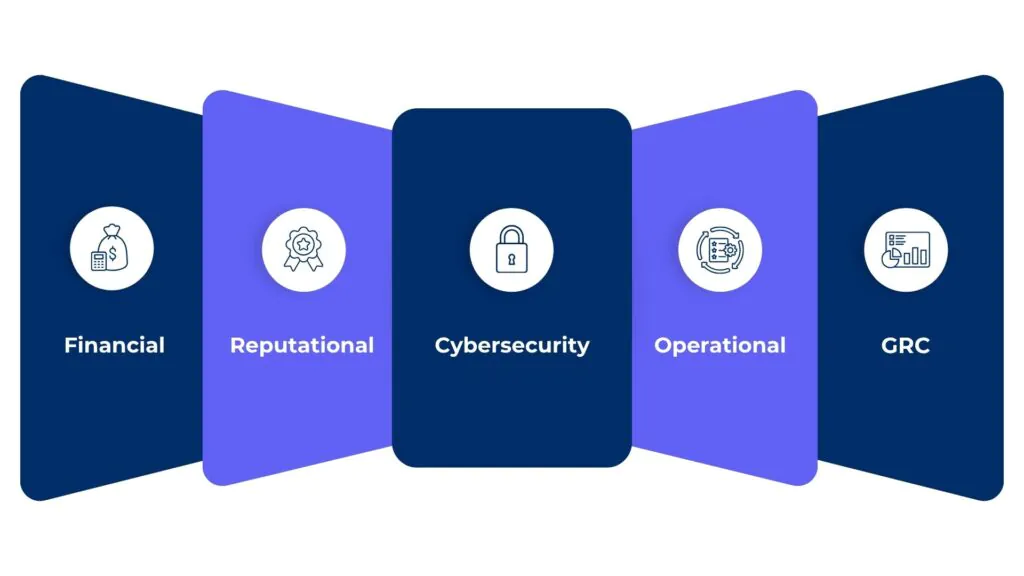
Third-party risk extends beyond cybersecurity. A vendor can introduce risks related to sensitive data, regulatory requirements, business continuity, finances, and reputation, depending on the services it provides and how closely it connects to your organization. Here are the main types of third-party risk companies should consider when assessing vendors:
Financial risk
A financially unstable vendor may struggle to maintain services, invest in security, or continue operating altogether. Financial health becomes particularly important when assessing providers that support critical infrastructure, customer-facing services, or other operations that would be difficult to replace quickly.
Reputational risk
A third party’s actions can also affect how customers, partners, and regulators perceive your organization. Security incidents, unethical practices, privacy failures, or regulatory violations involving an important vendor can create reputational consequences even when the activity occurs outside your organization.
Cybersecurity risk
Cybersecurity risk arises when a third party has access to your systems, networks, credentials, or sensitive information. Effective cybersecurity risk management involves assessing vendor controls such as access management, encryption, vulnerability management, and incident response to reduce third-party security exposure.
Operational risk
Operational risk focuses on whether a vendor failure could disrupt important business activities. Companies should consider how dependent they are on the provider, whether alternative suppliers are available, and what business continuity and disaster recovery measures the vendor maintains.
GRC risk
Third parties can introduce Governance, Risk, and Compliance (GRC) issues when they handle sensitive data, access critical systems, or support regulated operations. Organizations should assess vendor controls, contractual obligations, certifications, and data practices to manage risk and meet requirements such as GDPR, HIPAA, SOC 2, ISO 27001, and SOX ITGC.
AI-native GRC for how teams work today.
Third-party risk management best practices
Effective TPRM requires more than annual vendor reviews and spreadsheets. Growing companies need repeatable processes that focus resources on the highest risks while keeping vendor information and evidence current. Here are six TPRM best practices for building a more scalable program.
1. Maintain a complete, continuously updated vendor inventory
Maintain a centralized inventory of every third party your organization relies on, including vendors, subprocessors, fourth parties, and shadow IT. Gather information from procurement, finance, IT, security, and business teams to identify external parties with access to company systems, data, or critical operations.
For each vendor, record the business owner, services provided, data handled, system access, contract status, and renewal dates. This context makes the inventory useful for risk assessments, audits, incident response, and ongoing monitoring rather than simply serving as a list of vendor names.
2. Tier and prioritize vendors by risk level
Prioritize vendors based on data sensitivity, system access, and business criticality rather than reviewing every vendor the same way. For example, a cloud provider or payroll processor typically requires more scrutiny than a scheduling tool with no access to sensitive information.
Use a third-party risk assessment to classify vendors as low, medium, or high risk based on clear criteria. This helps security and compliance teams apply the right level of due diligence and monitoring, focusing deeper reviews on vendors that could have the greatest impact.
3. Automate vendor risk assessments and continuous monitoring
Automate vendor risk assessments and supplement point-in-time questionnaires with continuous monitoring. Annual reviews can quickly become outdated when a vendor changes its infrastructure, security controls, subprocessors, or data practices between assessments.
Vendor risk assessment software can centralize questionnaires, supporting evidence, risk scoring, and remediation follow-ups, reducing the manual work required for each review. This also helps teams identify changes in vendor risk between formal assessments and respond sooner when issues emerge.
4. Standardize vendor security requirements in contracts
Establish consistent contractual security requirements, right-to-audit clauses, and breach-notification SLAs for relevant vendors. Standard requirements make expectations clearer and reduce inconsistencies between contracts as the number of third-party relationships increases.
Define baseline requirements covering areas such as encryption, access controls, incident notification timelines, subprocessor disclosure, and security evidence. Procurement, legal, compliance, and security teams can then use the same baseline when reviewing new contracts and renewals.
5. Build a formal vendor offboarding process
Create a documented offboarding process that revokes vendor access and confirms that company data is appropriately returned or deleted. Ending a contract does not automatically remove risk, as dormant accounts, active integrations, credentials, and retained data may remain after the relationship ends.
Coordinate offboarding across IT, identity management, procurement, security, and the relevant business owner. Confirm access removal, disable integrations, recover assets where applicable, and obtain evidence of data deletion or destruction when required.
6. Map vendor controls to compliance frameworks
Map vendor risk controls and evidence to the compliance frameworks on your roadmap, including SOC 2, ISO 27001, GDPR, HIPAA, and SOX ITGC. The same vendor assessments, contracts, monitoring records, and remediation evidence can often support requirements across multiple frameworks.
Centralizing this information prevents teams from rebuilding the same evidence for every audit or customer request. When evaluating TPRM software, prioritize capabilities such as evidence reuse, cross-framework mapping, automated assessments, and centralized reporting.
Third-party risk management best practices at a glance
| Best practice | What to implement | Primary benefit |
| Maintain a complete vendor inventory | Track vendors, subprocessors, fourth parties, ownership, access, data handled, and renewal dates | Complete visibility into third-party exposure |
| Tier vendors by risk | Classify vendors using data sensitivity, system access, and business criticality | Focus resources on higher-risk vendors |
| Automate assessments and monitoring | Centralize questionnaires, evidence, scoring, remediation, and continuous monitoring | Faster reviews and more current risk visibility |
| Standardize contract requirements | Establish security terms, right-to-audit clauses, and breach-notification SLAs | Clearer and more consistent vendor accountability |
| Formalize vendor offboarding | Revoke access, disable integrations, and confirm data deletion | Reduce residual risk after contracts end |
| Map controls to frameworks | Reuse vendor controls and evidence across SOC 2, ISO 27001, GDPR, HIPAA, and SOX ITGC | Less duplicate work and greater audit efficiency |
Always-on GRC. Built for modern teams.
How long does it take to implement a third-party risk management program?
Most mid-sized companies can establish the foundations of a third-party risk management program in 4–8 weeks, while reaching continuous monitoring maturity typically takes 3–6 months. The initial phase usually includes building a complete vendor inventory, assigning risk tiers, defining ownership, and establishing consistent assessment processes that support ongoing monitoring and continuous compliance.
The exact timeline depends on the number and complexity of vendors, existing processes, and the tools being used. A company with 40 vendors, centralized procurement, and automated workflows can move much faster than one managing 300 vendors across spreadsheets, email-based assessments, and shadow IT.
Compliance deadlines can also determine how quickly a TPRM program needs to mature. Companies preparing for a SOC 2 audit or aligning with ISO 27001 need sufficient time to assess relevant vendors, collect evidence, address identified risks, and document repeatable processes before their audit.
Third-party risk management costs and ROI
TPRM costs typically include internal team time, assessment and monitoring tools, and the potential financial impact of weak vendor oversight. Automation can help make these costs more manageable as vendor volumes increase. Here are the main costs to consider and where TPRM automation can deliver ROI.
Internal team and tooling costs
Manual vendor assessments require time from security, compliance, legal, procurement, and business owners. Questionnaires, evidence reviews, risk scoring, and follow-ups can quickly consume significant resources as vendor numbers grow. Risk management platforms add a direct cost but can reduce the resources needed to oversee a growing vendor base.
The cost of weak third-party oversight
Poor vendor oversight can result in breach response costs, regulatory penalties, audit findings, and remediation work. Incomplete assessments can also delay enterprise deals or cause companies to fail customer due diligence requirements. As reliance on third parties increases, these potential costs become more significant.
ROI of TPRM automation
Automation reduces the manual effort required for vendor intake, assessments, scoring, evidence collection, and follow-up. This allows teams to manage more vendors without increasing security and compliance headcount at the same rate. Centralized evidence can also be reused across audits, customer questionnaires, compliance frameworks, and internal reporting.

How Scytale simplifies third-party risk management
Scytale centralizes vendor risk management alongside your broader compliance program, replacing scattered questionnaires, spreadsheets, and manual follow-ups with one streamlined process. Teams can automate vendor assessments, assign risk levels, track remediation, manage supporting evidence, and maintain visibility into third-party risks as their vendor ecosystem grows.
Because vendor controls and evidence connect directly with your compliance work, Scytale also helps reduce duplicate effort across frameworks such as SOC 2, ISO 27001, GDPR, HIPAA, and SOX ITGC. Combined with automated workflows and dedicated GRC expert support, teams can spend less time chasing vendor information and more time addressing the risks that matter.
FAQs about third party risk management best practices
What are the key third-party risk management (TPRM) best practices?
The key third-party risk management best practices include maintaining a current vendor inventory, tiering vendors by risk, automating assessments, standardizing contracts, formalizing offboarding, and mapping controls to compliance frameworks. Together, these steps help growing companies review the right vendors, reuse evidence, and keep oversight current as vendor counts rise.
How often should you reassess third-party vendors?
You should reassess third-party vendors based on their risk tier, not on one fixed annual schedule. High-risk vendors often need continuous monitoring plus periodic formal reviews, while lower-risk vendors need lighter reassessment. Scytale’s AI GRC platform helps teams apply different review cadences without losing visibility across the full vendor base.
What are the biggest TPRM challenges for growing companies?
The biggest TPRM challenges for growing companies include incomplete vendor visibility, limited security resources, inconsistent assessments, and poor evidence reuse. Automation and risk-based prioritization help teams address these challenges as their vendor ecosystem grows.
Which compliance frameworks require a TPRM program?
SOC 2, ISO 27001, GDPR, and HIPAA all require or expect organizations to maintain appropriate third-party oversight. This includes assessing relevant vendors, monitoring potential risks, and keeping clear records of due diligence. While specific requirements vary by framework, each emphasizes the importance of managing third-party risk throughout the vendor relationship.
How can small teams automate TPRM without adding headcount?
Small teams can automate TPRM by centralizing vendor records, standardizing questionnaires, using risk-based tiering, and continuously monitoring vendors. Top AI GRC platforms like Scytale support this with automated assessments, a centralized vendor risk register, and framework mapping. This reduces manual work and makes audits and buyer reviews easier to manage.
