


TL;DR: Third-party risk management lifecycle
- The third-party risk management lifecycle structures vendor oversight from initial planning and intake through final offboarding.
- Vendor risk changes after contract signature, so a continuous TPRM lifecycle outperforms one-time, point-in-time assessments.
- Mature programs connect due diligence, onboarding, control implementation, inventory, and monitoring in one operating model.
- Automation reduces manual follow-up, centralizes vendor evidence, and keeps reassessments on schedule as vendor volume grows.
- Scytale’s AI GRC platform supports the full vendor lifecycle with automated evidence collection, continuous monitoring, and expert GRC guidance.
Third-party risk rarely fails at the assessment stage alone. It typically breaks down when organizations treat vendor reviews as a one-time task and lose visibility once contracts go live.
A mature lifecycle closes that gap by connecting intake, due diligence, onboarding, monitoring, and offboarding into one repeatable operating model rather than a collection of disconnected reviews. Each stage gives teams a defined checkpoint, so vendor exposure stays current as relationships evolve. In this article, we explain the seven lifecycle stages, the most common program gaps, and where automation adds the most value.
What is the third-party risk management lifecycle?
The third-party risk management lifecycle is the end-to-end process organizations use to identify, assess, onboard, monitor, and offboard the external parties that access their systems, data, or operations.
The lifecycle turns third-party risk management (TPRM) into a repeatable operating model rather than a one-time assessment. Vendor risks evolve throughout the business relationship as access permissions, data handling practices, subcontractors, and security controls change. A comprehensive approach ensures organizations maintain oversight, regularly reassess risks, and apply appropriate controls beyond the initial vendor selection process.
The lifecycle also creates accountability across security, procurement, legal, privacy, and business owners. When each stage has a defined purpose and owner, teams identify issues earlier, apply controls faster, and maintain a current view of vendor exposure. This structure matters most when the vendor base grows faster than review capacity, since a documented TPRM lifecycle helps organizations prioritize high-impact relationships, standardize evidence requests, and avoid duplicate work across the broader compliance program.
Streamline GRC workflows with no blind spots.
The 7 stages of the TPRM lifecycle
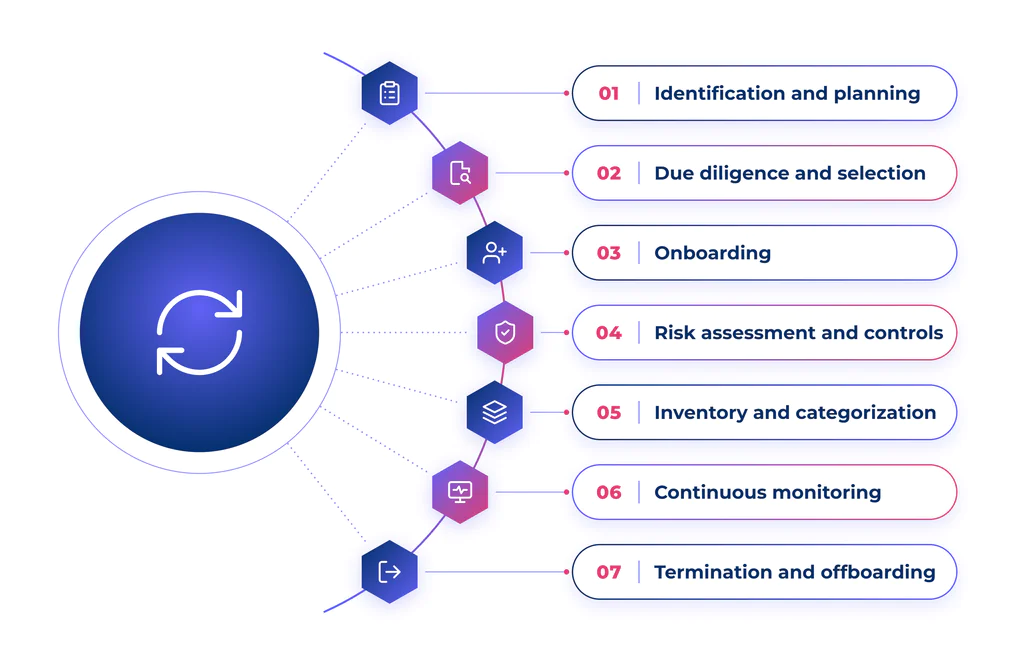
The seven stages of the TPRM lifecycle work together to help organizations identify, assess, and manage third-party risks throughout a vendor relationship. Each stage builds on the previous one, from initial planning and due diligence to ongoing monitoring and offboarding. A structured approach helps teams maintain visibility, apply appropriate controls, and address risks before they become larger issues. Here are the seven stages of the TPRM lifecycle and what each involves:
1. Third-party identification and planning
The TPRM lifecycle begins before vendor selection, when organizations identify the business need for a third party and the potential risks involved. This includes defining the scope of services, assigning an internal owner, identifying the types of data the vendor will access, and determining how critical the relationship is to business operations. Establishing these details early helps teams understand the level of oversight required and avoid gaps during later assessments.
Organizations should also establish risk criteria, tolerance thresholds, and clear responsibilities to guide vendor evaluations. Initial screening helps determine whether a vendor requires a basic review or a more detailed assessment based on factors such as data sensitivity, system access, and regulatory requirements. This ensures that high-risk vendors receive appropriate scrutiny without creating unnecessary work for lower-risk relationships.
2. Due diligence and selection
Due diligence helps organizations evaluate whether a potential vendor meets their security, compliance, and operational requirements before signing a contract. Teams typically review security policies, certifications, audit reports, privacy practices, incident history, and financial stability to identify potential risks. They may also use standardized questionnaires and evidence requests to assess the vendor’s controls and determine whether additional safeguards are necessary.
This stage should also consider fourth-party risks, including subcontractors that may handle sensitive data or support critical services. Comparing vendors against consistent evaluation criteria helps organizations make informed decisions based on risk, reliability, and business needs rather than cost alone. For a closer look at this process, see our guide to vendor due diligence.
3. Onboarding
Once a vendor is approved, onboarding ensures the relationship begins with the appropriate security and compliance requirements in place. Teams finalize contracts, confirm service expectations, assign internal responsibilities, and document the vendor in a centralized system. This process helps establish accountability and ensures that approved vendors meet the organization’s requirements before accessing systems or sensitive information.
Contracts play an important role in risk mitigation by defining obligations such as breach notification timelines, data protection requirements, service level agreements, and audit rights. Each requirement should have a clear owner responsible for ensuring it is implemented and maintained. Effective onboarding also creates a reliable baseline for future monitoring, assessments, and compliance reviews.
4. Risk assessment and implementation of controls
This stage focuses on evaluating vendor risk and implementing safeguards that address identified exposures. Organizations assess potential security, privacy, operational, financial, and legal risks based on the vendor’s services, access levels, and business criticality. The results help teams determine the appropriate controls and prioritize areas that require additional attention.
Controls may include access restrictions, encryption requirements, contractual safeguards, business continuity plans, and regular security reviews. Because the types of vendor risk vary across relationships, organizations should tailor their controls to each vendor’s risk profile rather than applying the same requirements to everyone. Assigning remediation owners, deadlines, and follow-up actions ensures that assessments lead to measurable improvements rather than risk scores alone.
5. Inventory and categorization
Maintaining an accurate vendor inventory gives organizations visibility into their third-party relationships and associated risks. Each record should include the vendor’s services, internal owner, data access, system integrations, business criticality, and assessment history. Centralizing this information makes it easier to track relationships, identify gaps, and support compliance reviews.
Categorization helps teams prioritize vendors based on factors such as data sensitivity, access privileges, geographic location, and operational importance. Higher-risk vendors may require more frequent assessments and stricter controls, while lower-risk relationships can follow simpler review processes. Keeping the inventory updated also helps organizations identify unapproved tools and vendors that may otherwise remain outside formal oversight.
6. Continuous monitoring
Continuous monitoring helps organizations maintain oversight of vendor risks after onboarding and initial assessments are complete. Teams track security incidents, changes in vendor controls, contract renewals, compliance certifications, and reassessment deadlines to identify emerging issues. This ongoing approach is important because a vendor’s risk profile can change as its services, systems, and business relationships evolve.
Organizations can strengthen monitoring by connecting TPRM activities with broader vendor risk management (VRM) workflows and defining key performance indicators (KPIs) and key risk indicators (KRIs). These measures help teams evaluate vendor performance, identify control gaps, and prioritize follow-up actions. Events such as expired certifications, security breaches, or new subcontractor relationships should also trigger reassessments rather than waiting for the next scheduled review.
7. Termination and offboarding
Termination and offboarding ensure that ending a vendor relationship does not leave security or compliance risks unresolved. Organizations should revoke system access, deactivate API credentials, confirm the return or deletion of sensitive data, and review any remaining contractual obligations. Updating the vendor inventory and documenting completed actions also helps maintain accurate records for future audits.
Without a structured offboarding process, former vendors may retain access to systems, sensitive information, or resources they no longer need. Teams should verify that access has been removed, request confirmation of data deletion where appropriate, and retain supporting documentation. These steps help reduce residual risk and demonstrate that third-party relationships are managed throughout their entire lifecycle.
Seven stages of the TPRM lifecycle at a glance
| Stage | Primary goal | Key output | Common risk if skipped |
| Third-party identification and planning | Define business needs and potential risks | Vendor intake record and assigned owner | Inadequate risk screening |
| Due diligence and selection | Evaluate vendor suitability | Risk-informed vendor selection | Undetected security and compliance gaps |
| Onboarding | Establish requirements and responsibilities | Documented vendor relationship and obligations | Unmanaged contractual requirements |
| Risk assessment and implementation of controls | Identify risks and apply safeguards | Risk assessment and remediation plan | Unaddressed vulnerabilities |
| Inventory and categorization | Maintain visibility across vendors | Updated and categorized vendor inventory | Incomplete vendor oversight |
| Continuous monitoring | Track changes and emerging risks | Ongoing assessments and risk alerts | Risks going undetected |
| Termination and offboarding | Securely close vendor relationships | Documented offboarding and access removal | Residual access and data exposure |



How to automate the TPRM lifecycle
Automation delivers the greatest value when teams manage a high volume of vendors with limited review capacity. The objective is not to remove professional judgment but to remove the repetitive coordination work that slows down the third party risk management process. Here are the stages that benefit most from automation and why:
Automate intake and routing
Structured intake forms collect the same facts for every request and route vendors by risk tier automatically. This reduces back-and-forth with business owners and prevents low-risk requests from crowding high-risk review queues. Automated discovery of software already in use can also surface shadow IT vendors that never passed through procurement.
Automate evidence collection and review
Questionnaires, policy requests, and document reviews consume a large share of analyst time. AI-powered TPRM helps teams gather evidence faster, flag missing items, and keep review records consistent across vendors, while automated scoring applies the same logic to every response so vendors can be compared on an equal basis.
Automate inventory updates and reassessments
A central system should update ownership, status, review dates, and risk categories without manual spreadsheet reconciliation. Automated reminders and automated vendor risk assessment workflows keep reassessments on schedule and reduce the likelihood that critical vendors go unreviewed.
Automate monitoring and escalation
Monitoring workflows should surface changes in vendor posture, approaching contract milestones, and unresolved remediation items. When alerts are tied directly to owners and deadlines, teams spend less time triaging and more time reducing risk, while leadership gains a shared view of key risk indicators across the vendor base.
Common TPRM lifecycle mistakes
Even with a structured approach to vendor risk management, gaps in ownership, incomplete vendor inventories, and inconsistent reassessments can leave organizations exposed. These issues often arise when teams lack clear processes for monitoring third-party risks throughout the vendor lifecycle. Here are the most common TPRM lifecycle mistakes to avoid:
Treating TPRM as a one-time review
The most common mistake is treating pre-contract due diligence as the entire program. A questionnaire completed before signature does not replace onboarding controls, continuous monitoring, or formal offboarding, and it reveals little about how the vendor’s posture will change over a multi-year relationship.
Running disconnected processes
When procurement, security, legal, and privacy each track vendors in separate tools, the organization loses a single source of truth and teams spend time reconciling records instead of reducing risk. Consolidating vendor oversight within a broader governance, risk and compliance (GRC) program gives every function the same view of each relationship.
For example, Sport Alliance used Scytale to centralize policy, risk, vendor, and compliance management in one platform, replacing fragmented processes across Confluence, Google Workspace, and its previous GRC tool.
Applying the same review depth to every vendor
Uniform review depth spends analyst capacity on low-risk vendors while high-risk relationships receive insufficient scrutiny. Risk-based categorization keeps teams focused on the vendors with the greatest access, data sensitivity, or operational dependency. Assessments limited to cybersecurity also tend to miss the operational, financial, and reputational risks a vendor can introduce.
Leaving ownership and scope unclear
If no business owner, security lead, or compliance contact owns a relationship after approval, remediation items linger and reassessments slip. Scope confusion creates a similar problem, since teams that conflate TPRM vs VRM often build programs with blurred boundaries. Clear definitions help organizations decide which third parties require formal review, which vendors need lighter oversight, and where fourth-party exposure enters the picture.
Always-on GRC. Built for modern teams.
How Scytale streamlines third-party risk management
Scytale helps organizations run third-party risk management as a connected program rather than a series of manual checkpoints. Its AI GRC platform centralizes vendor intake, evidence collection, review workflows, and inventory visibility, while continuous monitoring keeps vendor posture current between formal reviews. These capabilities matter most in the stages with the heaviest coordination load, including due diligence, onboarding, reassessments, and monitoring, where automated workflows route actions to the right owners and keep records audit-ready.
The platform also supports cross-framework control mapping, so teams can connect vendor evidence to broader obligations under SOC 2, ISO 27001, GDPR, and other frameworks without duplicating work. With 150+ integrations and AI agents that review evidence and flag gaps, security and compliance teams gain a stronger operational view of third-party exposure. Paired with dedicated GRC experts who guide teams through program design and remediation, Scytale helps organizations replace spreadsheets and inbox follow-up with a consistent, scalable TPRM lifecycle that stays ready for audit.
FAQs about third-party risk management lifecycle
What are the stages in a third-party risk management lifecycle?
The seven stages are identification and planning, due diligence and selection, onboarding, risk assessment and implementation of controls, inventory and categorization, continuous monitoring, and termination and offboarding. Together, they help organizations manage vendor risk across the full relationship rather than relying on one-time reviews.
How is TPRM different from vendor risk management?
TPRM typically covers a broader set of external relationships than vendor risk management. Vendor risk management generally focuses on suppliers that provide products or services, while TPRM also includes contractors, partners, affiliates, and other external entities that introduce operational, security, or compliance risk.
How often should third parties be reassessed?
Reassessment frequency should depend on each vendor’s risk tier, access level, data sensitivity, and business criticality. High-risk vendors often require more frequent reviews, while lower-risk vendors follow a lighter cadence, and events such as a breach or ownership change should trigger an earlier review. Scytale’s AI GRC platform helps teams keep reassessments on schedule by centralizing review dates, ownership, and monitoring workflows.
Who owns third-party risk in an organization?
Third-party risk is typically shared across several functions rather than owned by one team. Security, compliance, procurement, legal, privacy, and business owners each play a role, but a single program owner should coordinate the lifecycle, standards, and escalation path. Leading AI GRC platforms like Scytale support this model by giving cross-functional teams one place to manage vendor reviews and follow-up.
What is fourth-party risk?
Fourth-party risk is the risk an organization inherits from its vendors’ own suppliers, subprocessors, and service providers. It matters because a direct vendor may depend on another party for hosting, support, or data processing, so thorough due diligence and monitoring are needed to identify where those indirect dependencies create exposure.
