








TL;DR: GRC audit
- A GRC audit reviews governance, risk, and compliance together instead of checking one framework in isolation.
- A strong GRC audit process helps your team spot control gaps, ownership issues, and evidence problems before they delay reviews.
- Internal, external, and regulatory audits each test your program from a different angle and require different preparation.
- A practical GRC audit checklist keeps documents, control evidence, and stakeholder responsibilities organized before fieldwork starts.
- Scytale’s AI GRC platform helps teams stay GRC audit-ready with continuous monitoring, evidence collection, and audit management workflows.
Audit pressure rarely comes from one direction. Organizations face board oversight, customer due diligence, internal reviews, and framework obligations at the same time, which turns a GRC audit into a business-wide test of readiness rather than a single compce exercise.
A fragmented compliance program makes that test slower and less reliable. When governance decisions, risk tracking, and compliance evidence sit in separate systems, teams spend more time reconciling records than proving that controls actually work. In this article, we explain how a GRC audit works and how to prepare your organization for one.
What is a GRC audit?
A GRC audit is a structured review of how an organization governs decisions, manages risk, and meets compliance obligations as one connected program.
While framework-specific audits focus on defined requirements, a GRC audit takes a broader view of how governance, risk management, and compliance activities work together across the organization. It applies the broader logic of governance, risk, and compliance (GRC) to the audit itself, so policies, ownership, and reporting are assessed as one system rather than as separate checklists.
That broader scope matters because audit findings often start at the seams between teams. A policy, a risk register, and a full set of evidence may all exist, yet the audit can still surface significant findings if ownership, escalation, and monitoring do not line up in practice.
AI-native GRC for how enterprise teams work today.
Why GRC audits matter
GRC audits help organizations evaluate governance, risk, and compliance together, providing a clearer view of their overall risk and compliance posture. By assessing the effectiveness of an organization’s GRC program, they reveal how well controls, policies, and processes support business objectives. Here are the key benefits of conducting regular GRC audits:
Improved business visibility
GRC audits provide leadership with a centralized view of organizational risks, compliance obligations, and governance processes. This visibility helps identify gaps in controls, accountability, and oversight before they become larger business risks.
Stronger risk identification and prioritization
GRC audits help identify emerging risks, control weaknesses, and compliance gaps across business functions. By assessing their potential impact, organizations can prioritize critical risks and allocate resources more effectively.
More effective compliance management
GRC audits help businesses assess whether their controls and processes align with regulatory requirements and industry standards. Identifying overlapping controls across frameworks reduces duplicate work and simplifies ongoing GRC compliance.
Greater accountability and governance
Regular GRC audits clarify responsibilities by evaluating how risks, controls, and compliance activities are managed. They help identify unclear ownership and gaps in oversight, ensuring issues are addressed by the appropriate teams.
Improved reporting and decision-making
GRC audits provide structured findings and measurable insights into organizational risk and compliance performance. Centralized reporting helps leadership track remediation progress, identify recurring issues, and measure improvements over time.
Reduced operational inefficiencies
GRC audits identify redundant processes, manual tasks, and duplicated compliance activities. These insights help organizations streamline workflows, introduce automation, and reduce administrative work.
Stronger audit readiness and continuous improvement
Regular GRC audits help organizations identify and resolve control weaknesses before they become significant compliance issues. Ongoing assessments and remediation tracking strengthen security practices, support continuous improvement, and maintain audit readiness.
Streamline GRC workflows with seamless automation.
Types of GRC audits
GRC audits can take different forms depending on an organization’s objectives, regulatory requirements, and level of oversight needed. While a GRC audit is not a single standardized audit category, internal, external, and regulatory reviews can each assess different aspects of an organization’s governance, risk, and compliance program. Here are the three main types of GRC audits:
Internal GRC audits
An internal compliance audit focuses on readiness and improvement, helping teams find gaps before a customer, board committee, or outside auditor does. Internal reviews typically test policy alignment, control ownership, evidence quality, issue tracking, and remediation follow-through.
External GRC audits
External GRC audits bring independent scrutiny to the program and often support certifications, attestations, or buyer trust. These reviews place more weight on consistency, traceability, and whether evidence proves control performance over a defined period.
Regulatory GRC audits
Regulatory GRC audits examine whether the organization meets obligations tied to laws, sector rules, or supervisory expectations. These reviews often demand tighter documentation, clearer escalation records, and stronger proof that management acted on known risks, which makes compliance risk management a central focus.
Comparison of GRC audit types
| Audit type | Primary purpose | Who performs it | Best use case |
|---|---|---|---|
| Internal GRC audit | Find gaps and improve readiness | Internal audit, compliance, or risk teams | Pre-audit reviews and program improvement |
| External GRC audit | Provide independent assurance | Third-party auditors or assessors | Certifications, attestations, and customer trust |
| Regulatory GRC audit | Test legal or supervisory alignment | Regulators or delegated examiners | Industries with formal oversight obligations |
How a GRC audit works: Step by step
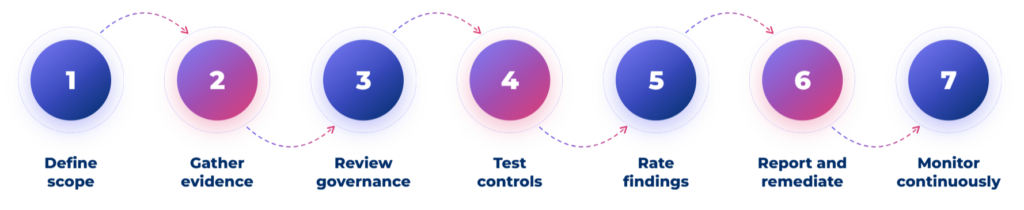
A structured GRC audit process follows a clear sequence, from defining the audit scope to evaluating controls, addressing findings, and monitoring ongoing compliance. Establishing clear responsibilities, organizing evidence, and coordinating across teams helps businesses reduce delays and improve audit efficiency. Here are the seven key steps of a GRC audit:
Step 1: Define scope and objectives
Start by identifying the audit’s objectives and determining which business units, systems, risks, and compliance frameworks fall within scope. Establish clear audit criteria, timelines, responsibilities, and stakeholders to guide the process. A well-defined scope helps prevent unnecessary work and ensures the audit focuses on the most relevant risks and controls.
Step 2: Gather documentation and evidence
Collect relevant documentation, including policies, risk registers, control descriptions, access reviews, training records, and previous audit findings. Centralizing these records through audit management software simplifies evidence collection and reduces repetitive requests. Ensure all evidence is accurate, up to date, and clearly linked to the controls being assessed.
Step 3: Review governance and risk ownership
Evaluate how effectively the organization manages governance responsibilities, risk ownership, and decision-making processes. Auditors review leadership oversight, escalation procedures, risk assessments, and documented approvals to confirm accountability. They also assess whether identified risks are regularly reviewed and addressed by the appropriate stakeholders.
Step 4: Test controls and supporting processes
Assess whether security, operational, and compliance controls are properly designed and functioning as intended. Auditors review system configurations, access logs, approvals, and supporting evidence to verify that controls operate effectively. Testing helps identify weaknesses, control failures, and potential compliance gaps across applicable frameworks.
Step 5: Evaluate findings and rate issues
Analyze audit findings based on their severity, root causes, and potential business impact. Determine whether identified issues result from ineffective controls, inconsistent processes, missing evidence, or unclear responsibilities. Prioritizing findings by risk helps organizations focus remediation efforts on the most critical weaknesses.
Step 6: Report results and assign remediation
Document audit findings, identified risks, and recommended corrective actions in a clear, structured report. Assign each issue to a responsible owner with a remediation plan, deadline, and relevant GRC metrics to track progress. Effective reporting helps leadership understand compliance gaps, monitor improvements, and ensure accountability.
Step 7: Follow up and monitor continuously
Verify that corrective actions have been implemented and that identified control weaknesses have been resolved. Implementing continuous controls monitoring helps organizations detect new risks, track control performance, and maintain updated audit evidence. This proactive approach reduces recurring findings, strengthens ongoing compliance, and makes future audits more efficient.
Always-on GRC. Built for modern teams.
GRC audit preparation checklist
Effective preparation helps GRC audits run smoothly by reducing delays, missing evidence, and unclear responsibilities. A practical GRC audit checklist ensures teams are aligned, documentation is organized, and controls are ready for review. Here are the key items to confirm before audit fieldwork begins:
- Scope confirmation: Define the business units, systems, frameworks, and controls included in the audit, document exclusions, and obtain approval for the final scope.
- Stakeholder roles: Assign owners to each audit workstream, establish a main point of contact for auditor requests, and confirm team availability.
- Control inventory: Ensure every control has a designated owner, clear description, supporting evidence, and defined review frequency.
- Policy review: Verify that policies reflect current operations, approvals are up to date, and any exceptions or compensating controls are documented.
- Risk records: Update risk registers, treatment plans, and risk acceptance decisions to reflect current risks and management actions.
- Third-party risk: Review vendor assessments, contracts, and due diligence records to ensure relevant third-party risks are properly documented.
- Evidence readiness: Centralize logs, screenshots, approvals, reports, and other supporting records with clear dates, ownership, and consistent compliance documentation standards.
- Issue tracking: Review outstanding findings, remediation plans, and supporting evidence to ensure identified issues are being addressed.
- Prior audit results: Confirm that previous audit findings have been resolved or have documented remediation plans, assigned owners, and realistic deadlines.
Common GRC audit challenges
GRC audits can be challenging, especially when organizations manage multiple frameworks, disconnected systems, and complex compliance processes. Without clear coordination and efficient workflows, audits can become time-consuming and resource-intensive. Here are some of the most common challenges businesses face:
Scattered documentation and evidence
When audit evidence is spread across multiple systems, collecting and verifying information becomes difficult. Without centralized GRC software to organize documentation and track evidence, teams risk missing records, duplicating work, and delaying the audit process.
Unclear ownership and responsibilities
Poor coordination between security, IT, legal, and compliance teams can create confusion over control ownership and remediation tasks. Without clearly assigned responsibilities, important issues may go unresolved and slow down audit progress.
Disconnected tools and manual processes
Legacy systems, spreadsheets, and tools that do not integrate make consistent compliance management more difficult. Manual processes increase the risk of errors, inconsistent records, and unnecessary administrative work.
Limited resources and audit fatigue
GRC audits require time, expertise, and coordination across multiple departments. Teams with limited resources may struggle to balance audit preparation with daily responsibilities, leading to delays and audit fatigue.
Last-minute audit preparation
Collecting evidence only before an audit can leave control gaps and outdated documentation undetected for months. Without continuous monitoring and regular reviews, organizations risk unexpected findings, rushed remediation, and repeated audit challenges.

How Scytale keeps you GRC audit-ready
Audit-ready organizations do not wait for the next review cycle to organize evidence. Scytale gives mid-market and enterprise SaaS teams an AI GRC platform for control monitoring, automated evidence collection, and audit management in one operating layer. AI agents review evidence, flag control gaps, and keep records current, while real-time dashboards give leadership visibility into control status, open findings, and remediation progress, so teams spend less time reconciling screenshots and spreadsheets.
This matters most when one control supports several obligations. The platform maps controls across 80+ frameworks, including SOC 2, ISO 27001, GDPR, and SOX ITGC, and connects to 150+ systems to keep evidence current between reviews rather than only during audit week. Combined with continuous monitoring, built-in remediation workflows, and dedicated GRC experts, Scytale helps organizations maintain cleaner records, close findings faster, and stay ready for every GRC audit.
FAQs about GRC audit
What is a GRC audit?
A GRC audit is a structured review of how an organization governs decisions, manages risk, and meets compliance obligations as one connected program. It examines how policies, controls, ownership, reporting, and remediation work together, rather than checking alignment to a single framework.
What is the difference between a GRC audit and a compliance audit?
A GRC audit reviews the full operating model across governance, risk, and compliance. A compliance audit usually tests alignment to one framework or obligation, such as SOC 2 or ISO 27001, without examining the broader decision structure and risk management process in the same depth.
How often should a GRC audit be done?
Organizations should conduct GRC audits regularly, based on their risk exposure, regulatory obligations, and business complexity. Annual reviews are a common starting point, while Scytale’s AI GRC platform supports continuous control monitoring, automated evidence collection, and ongoing audit readiness between formal assessments.
Who performs a GRC audit?
A GRC audit may be performed by internal audit teams, compliance leaders, external auditors, or regulators, depending on the objective. Internal reviews focus on readiness and improvement, while outside reviewers provide independent assurance or test alignment with legal and supervisory expectations.
What documents and evidence are needed for a GRC audit?
A GRC audit usually requires policies, risk registers, control descriptions, issue logs, approvals, access reviews, training records, and proof of remediation. Scytale’s AI GRC platform helps teams keep this evidence organized and current, which reduces last-minute collection work and improves traceability during fieldwork.
