








TL;DR: GRC engineering
- GRC engineering applies engineering discipline to governance, risk, and compliance work.
- Teams adopt GRC engineering to replace manual evidence collection, spreadsheet tracking, and disconnected workflows.
- Automation plays a central role by connecting systems, testing controls, and reducing repeated compliance work.
- Continuous monitoring gives compliance teams faster visibility into control drift and operational gaps.
- Scytale’s AI GRC platform supports a GRC engineering approach with automation, integrations, and cross-framework control mapping.
Manual governance, risk and compliance (GRC) processes typically break down as compliance requirements grow. As frameworks multiply and evidence requests accumulate, spreadsheets and point-in-time reviews no longer give teams a reliable picture of control health. Audit preparation becomes a recurring cycle of chasing screenshots, exports, and approvals.
GRC engineering has emerged as a response to that pressure, treating compliance as a system to design, instrument, and improve rather than a set of recurring audit tasks. In this article, we explain what GRC engineering is, why teams are adopting it, and how to start building it into an existing program.
What is GRC engineering?
GRC engineering is the practice of applying engineering methods, automation, and systems thinking to governance, risk, and compliance work so that controls are monitored and evidenced continuously rather than periodically.
In practical terms, teams build repeatable workflows, connect source systems, define control logic, and reduce manual effort across the compliance lifecycle. The discipline sits inside the broader model covered in what is GRC, but it focuses on how teams design, run, and improve compliance operations every day. The result is a program that behaves like an operating system, with defined inputs, owners, and outputs, instead of a collection of documents refreshed before each audit.
The term gained traction as security and compliance programs outgrew spreadsheet-based coordination and practitioners began borrowing methods from software and security engineering. A group of GRC practitioners formalized many of these ideas in the GRC Engineering Manifesto, which prioritizes early automation, GRC-as-code, measurable risk outcomes, and continuous assurance over checkbox compliance and periodic monitoring. The shift reflects a simple operational reality: manual coordination does not hold up when cloud environments, vendors, and internal controls change every week.
Streamline GRC workflows with seamless automation.
Why compliance teams are adopting GRC engineering
As compliance requirements grow more complex, teams are looking for better ways to manage their GRC processes. Managing multiple frameworks, collecting increasing volumes of evidence, and preparing for frequent audits can quickly overwhelm teams relying on spreadsheets and disconnected tools. GRC engineering addresses these challenges through automation, connected systems, and continuous control monitoring, helping organizations reduce manual work and scale their compliance programs more efficiently. Here are the main reasons behind its growing adoption:
Pressure from manual work and growing scope
Collecting evidence from cloud platforms, HR systems, ticketing tools, and policy folders takes time and makes it harder to identify control drift between audits. As organizations expand into additional frameworks, compliance teams often face more evidence requests, reviews, and reporting requirements without additional resources. By automating evidence collection and control checks, teams can reduce manual effort and keep compliance activities aligned with changing requirements.
Ownership gaps in spreadsheet-driven programs
Spreadsheets and disconnected systems make it difficult to track control ownership, manage updates, and maintain accurate compliance records. Teams spend valuable time following up with stakeholders, reconciling information, and identifying who is responsible for addressing gaps. Centralizing controls, evidence, and responsibilities helps eliminate these bottlenecks and improves accountability.
For example, 2X Solutions replaced spreadsheets and disconnected systems with one centralized GRC platform, reducing internal compliance effort by 83% and giving the team continuous visibility into its compliance posture.
A more operational model for compliance
GRC engineering shifts compliance from periodic, audit-focused activities to an ongoing process integrated into everyday operations. Rather than manually gathering the same evidence for each audit, teams can connect their systems, automate control checks, and reuse evidence across multiple frameworks. This approach makes automating compliance more practical as organizations grow. Many teams start by automating repetitive tasks before expanding into continuous controls monitoring, automated testing, and real-time reporting. The result is less administrative work, clearer accountability, and a compliance program that can scale without requiring a proportional increase in headcount.
GRC engineering vs traditional GRC
While both approaches aim to manage governance, risk, and compliance effectively, they differ in how compliance activities are carried out. Traditional GRC relies heavily on manual processes, periodic reviews, and static documentation, while GRC engineering uses automation, connected systems, and repeatable workflows to streamline compliance management. Understanding these differences helps organizations choose an approach that reduces manual effort, improves visibility, and supports continuous compliance.
That shift changes both speed and reliability. When teams instrument controls and pull evidence directly from source systems, they spend less time preparing for audits and more time improving the control environment itself. The comparison also affects decision-making. Traditional GRC often shows where a compliance program stood at the last review, while GRC engineering provides a current view of control status, ownership, and exceptions. Here are the key differences between the two approaches:
| Approach | Traditional GRC | GRC engineering |
|---|---|---|
| Operating model | Periodic, audit-centered workflows | System-driven, repeatable compliance operations |
| Evidence collection | Manual screenshots, exports, and follow-ups | Automated collection from connected source systems |
| Control testing | Point-in-time validation | Continuous or scheduled testing with alerts |
| Framework management | Separate workstreams by framework | Shared controls mapped across frameworks |
| Reporting | Static status updates | Current dashboards and exception tracking |
| Team effort | High coordination overhead | Lower manual effort through GRC automation |
| Program maturity | Reactive and document-heavy | Operational and improvement-focused |


Core practices of GRC engineering
GRC engineering shows up in day-to-day work through a small set of operating practices rather than a single tool or project. The goal is not more tooling for its own sake, but a cleaner system for running controls, evidence, and remediation as the program grows. Here are the core practices that define the approach:
Control design as system design
Teams define each control with a clear owner, data source, review logic, and failure condition. This structure makes controls easier to test, easier to map across frameworks, and easier to improve when the environment changes, because every control has an explicit definition of what passing looks like.
Evidence collection from source systems
Mature programs pull evidence from the systems where work already happens rather than requesting it from control owners. Cloud platforms, identity providers, HR tools, ticketing systems, and code repositories become direct inputs into the compliance process, which removes manual exports and reduces the risk of outdated or incomplete evidence.
Control monitoring and exception handling
Teams monitor control health on a recurring or continuous basis instead of waiting for the next audit cycle. When a control fails or drifts, the program routes the issue to the right owner with context, due dates, and a record of remediation, so exceptions are resolved while they are still small.
GRC-as-code and version control
Many teams express policies, control logic, and test criteria as GRC-as-code, stored and versioned alongside other technical assets. This practice gives auditors a clear change history, allows control logic to be reviewed like any other code change, and makes it possible to embed compliance checks directly into deployment pipelines.
Cross-framework mapping
A mature program avoids duplicate work by mapping one control to multiple frameworks where the intent overlaps, such as SOC 2, ISO 27001, and GDPR. This practice supports progress along a GRC maturity model, because teams improve a control once and carry the benefit across the broader program.
Workflow standardization and reporting
GRC engineering relies on standard workflows for requests, approvals, reviews, and escalations. Leaders receive cleaner reporting because the program runs through defined states, instead of ad hoc updates spread across email, spreadsheets, and chat, and that reporting reflects current control health rather than last quarter’s status.
How to get started with GRC engineering
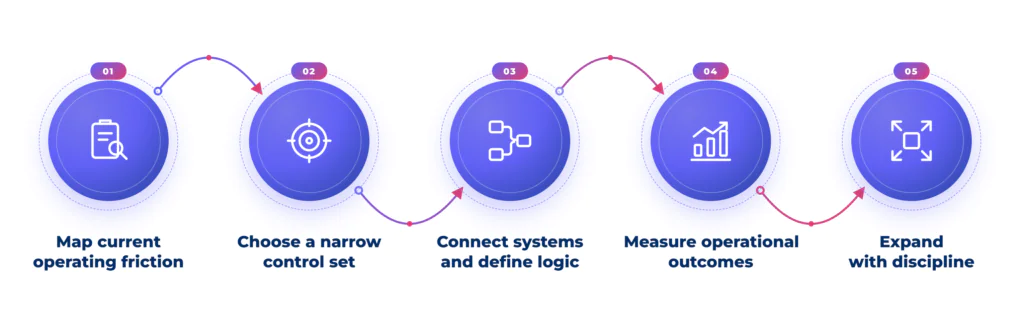
Small compliance teams do not need a full program rebuild to begin applying GRC engineering principles. The most realistic starting path focuses on one painful workflow, one set of controls, and one reporting problem that manual work consistently slows down. Here are the steps to get started:
Step 1: Map your current operating friction
Start by documenting where time goes today across the existing GRC program. Evidence chasing, duplicate framework work, unclear ownership, and late remediation usually reveal the first process worth redesigning, and recording current effort creates a baseline for measuring improvement later.
Step 2: Choose a narrow control set
Select a control family with frequent evidence requests and stable source systems, such as access reviews or employee onboarding. A narrow scope allows the team to prove value quickly and limits the risk of automating too many controls at once, which can compound errors before the logic has been validated.
Step 3: Connect systems and define logic
Identify the systems holding the evidence and connect them to your GRC tools to streamline data collection and control monitoring. Define what a passing result looks like for each control, then establish collection rules, review frequency, exception thresholds, and ownership to ensure consistent workflows while retaining human oversight for judgment-based controls.
Step 4: Measure operational outcomes
Track metrics tied to execution, not only audit outcomes. Time to collect evidence, number of manual requests, control failure resolution time, and framework reuse rates show whether the operating model is improving and where further automation would deliver the most value.
Step 5: Expand with discipline
Once the first GRC workflow runs reliably, extend the model to adjacent controls and frameworks. Teams that scale well keep the same principles throughout: source-system evidence, clear ownership, standardized workflows, and reporting that reflects current control health. Treating GRC engineering as an ongoing practice rather than a one-time project is what sustains those gains.
AI-native GRC for how teams work today.
How Scytale supports a GRC engineering approach
Scytale supports a GRC engineering approach by turning manual compliance work into structured, repeatable operations. The AI GRC platform connects evidence sources through native integrations, collects evidence automatically, and continuously monitors controls so that failures and drift surface between audits rather than during them. AI agents review evidence, flag control gaps, and trigger remediation tasks, giving teams the source-system evidence and exception handling that define GRC engineering in practice.
The platform also maps controls across 80+ frameworks, including SOC 2, ISO 27001, GDPR, HIPAA, and SOX ITGC, so teams improve a control once and reuse that work across every standard in scope. Combined with a customizable Trust Center and dedicated GRC experts who guide control design and audit preparation, Scytale helps small compliance teams raise program maturity, reduce manual coordination, and stay continuously audit-ready.
FAQs about GRC engineering
Why are compliance teams adopting GRC engineering?
Compliance teams adopt GRC engineering because manual evidence collection and spreadsheet tracking do not scale as frameworks, systems, and audit demands grow. Engineering-led workflows reduce repetitive work, clarify control ownership, and give teams a current view of control health instead of a point-in-time snapshot.
What role does automation play in GRC engineering?
Automation is the foundation of GRC engineering, connecting source systems, collecting evidence, and testing controls without manual requests. It frees compliance teams to focus on risk decisions and remediation rather than administration. Scytale’s AI GRC platform automates evidence collection and control testing across connected systems and frameworks.
How does GRC engineering support continuous compliance monitoring?
GRC engineering supports continuous monitoring by defining controls with clear data sources, test logic, and failure conditions that can be checked on a recurring basis. When a control fails or drifts, the issue is routed to its owner immediately rather than discovered at the next audit.
What challenges do organizations face when implementing GRC engineering?
Common challenges include unclear control ownership, limited technical skills within GRC teams, siloed compliance and engineering functions, and attempts to automate too many controls at once. Starting with a narrow control set and building cross-team collaboration early helps organizations avoid these issues.
How can organizations measure the success of a GRC engineering strategy?
Organizations can measure success through operational metrics such as time to collect evidence, number of manual requests, control failure resolution time, and framework reuse rates. Leading AI GRC platforms like Scytale provide dashboards that track these indicators alongside real-time control status and audit readiness.
